
[Reference: Private collection.]
16 January 2025
In 1895, Louis and Auguste Lumiere in Paris became the first people to succeed in projecting moving images on to a screen; soon afterwards, Thomas Edison did the same in the United States of America. The new technology proved immensely popular, but there were few suitable venues in which entertainment businesses could exploit the income-generating potential of what became known as cinematography. In the early years of the film industry, showmen added the bioscope, essentially a travelling cinema, to their attractions at fairs, seeking to persuade the crowds to pay for a glimpse of short dramatic films and news reports. Town halls and other large buildings were also hired by firms travelling the country with shows which combined films with variety acts. By 1910, local entrepreneurs realised that there was a huge market for film, and they rushed to open the first cinemas in Oxford; for a time, however, they also continued to hire the City’s large halls for special performances.
At the turn of the 20th century, Oxford City Council had two large modern venues, the Corn Exchange in George Street built between 1894 and 1895, and the Town Hall opened in 1897. Both contained large rooms which could be hired for meetings and entertainments, and this blog includes a selection from the many requests for film-related bookings sent by individuals and businesses to the curator of the municipal buildings. This correspondence is part of a remarkable collection of letters sent to the Town Clerk between 1870 and 1980 which is preserved in the Oxford City Archive in the Town Hall; as you can imagine, the letters cover a vast range of topics. The whole collection, and other City Archive material, can now be explored online through Oxfordshire County Council’s Heritage Search website – OXFORD TOWN CLERK – thanks to funding from Oxford City Council and the work of the City’s Archivist, Chris Gilliam.
For images in this blog post, click or tap the thumbnail to enlarge or view the whole image
Taunt had been using magic lanterns to entertain audiences since the 1870s. By inserting coloured or black and white slides into the mechanism, you could display a large image on the screen or wall opposite and create the illusion of movement by shifting from one lens to the other. Taunt’s subject matter varied enormously, from the trip down the Thames mentioned here to illustrated children’s stories for Christmas parties.
[Reference: Private collection.]
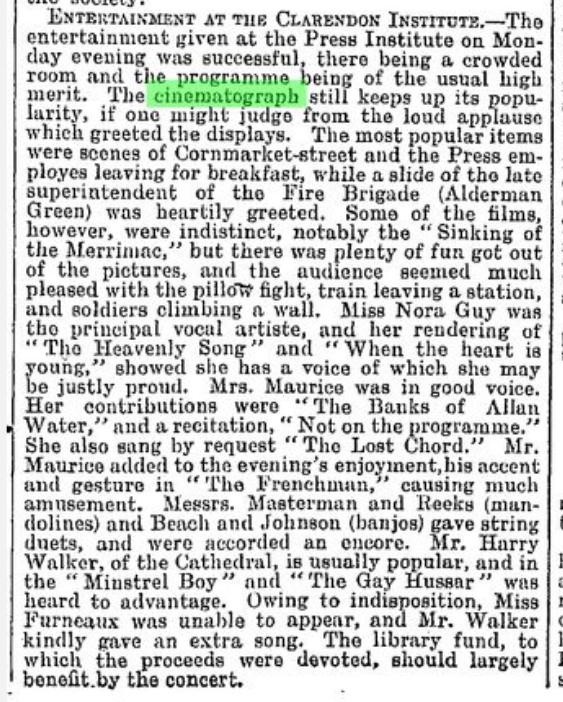
Report of an entertainment at the Clarendon Press Institute in Walton Street when the most popular films were a view of Cornmarket Street and scenes showing Press employees leaving for breakfast. These local films were probably the work of John Timms, a dealer in magic lantern materials, and the watchmaker and photographer, Henry Minn. The report notes that ‘Some of the films were indistinct, notably the “Sinking of the Merrimac”’, but the audience apparently enjoyed film of a pillow fight, a train leaving a station, and soldiers climbing a wall.
[Reference: Jackson’s Oxford Journal, 18 March 1899.]
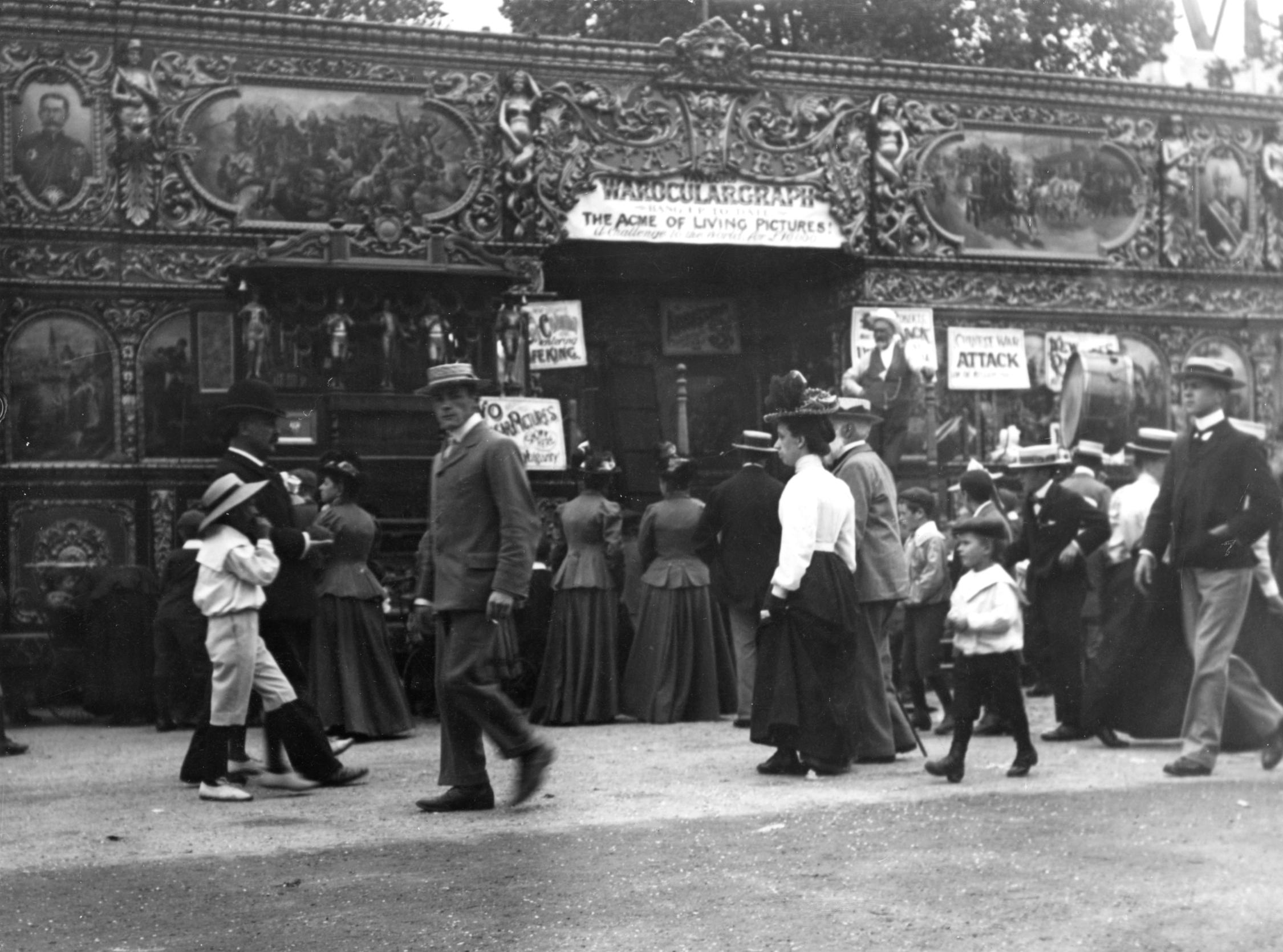
An organ to the left of the entrance, a fairground barker and a drum help to provide a noisy introduction to the show inside. The displayed poster including the word ‘Attack’ also aims to stimulate the curiosity of the crowd.
[Reference: POX0115800]
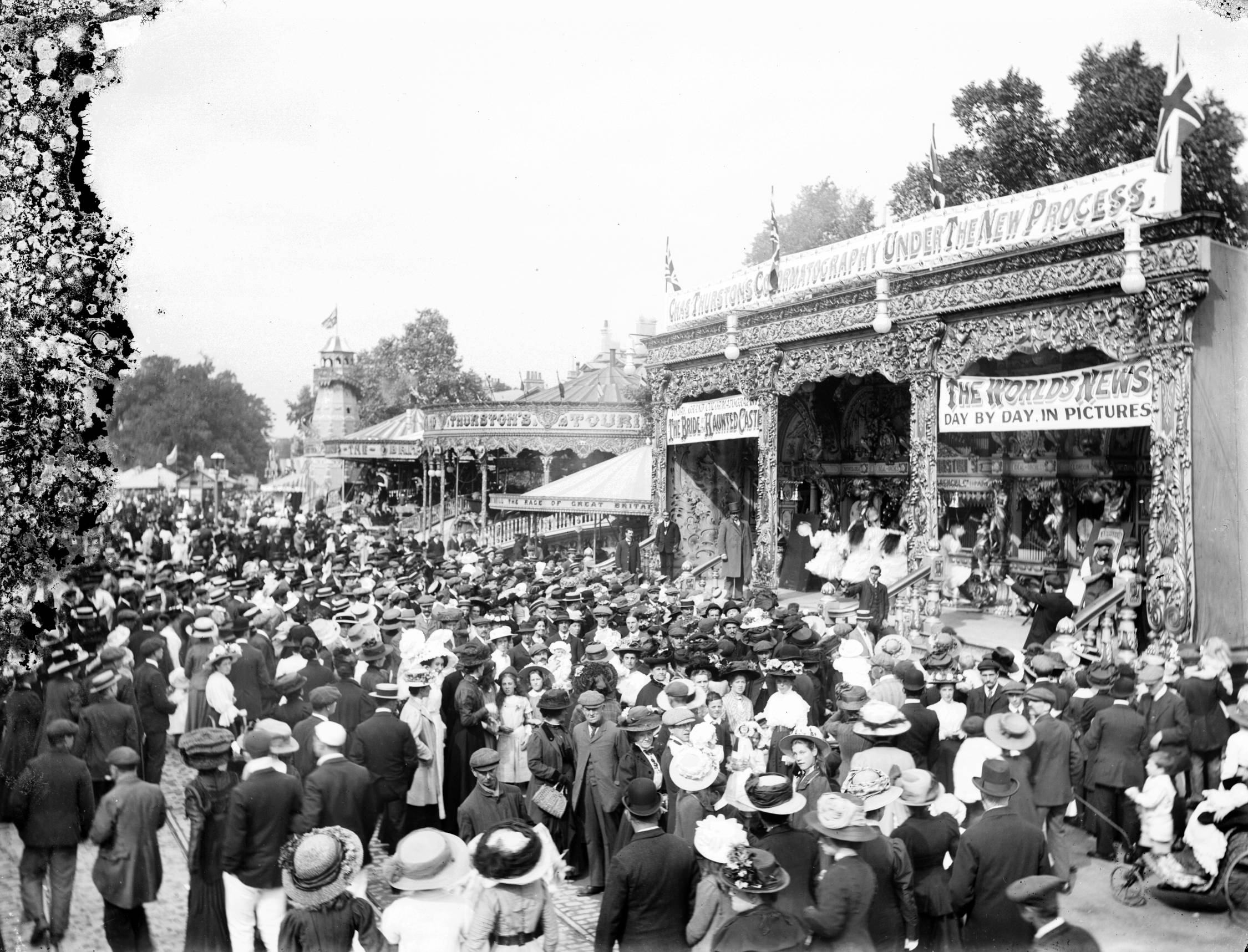
Dancing girls and the sound of an organ lure fairgoers towards films showing the News Day by Day in Pictures and a feature about The Bride in a Haunted Castle.
[Reference: POX0116129]
The Town Hall was lit by electricity from the beginning and the photograph shows the elaborate electroliers hanging from the ceiling which helped to illuminate this vast space. The first documented use of the room for a film show was on 17 January 1898 when the children of local Co-op members were entertained by a cinematograph. The hall later proved ideal for touring companies wishing to show films in the city.

[Reference: POX0109314]
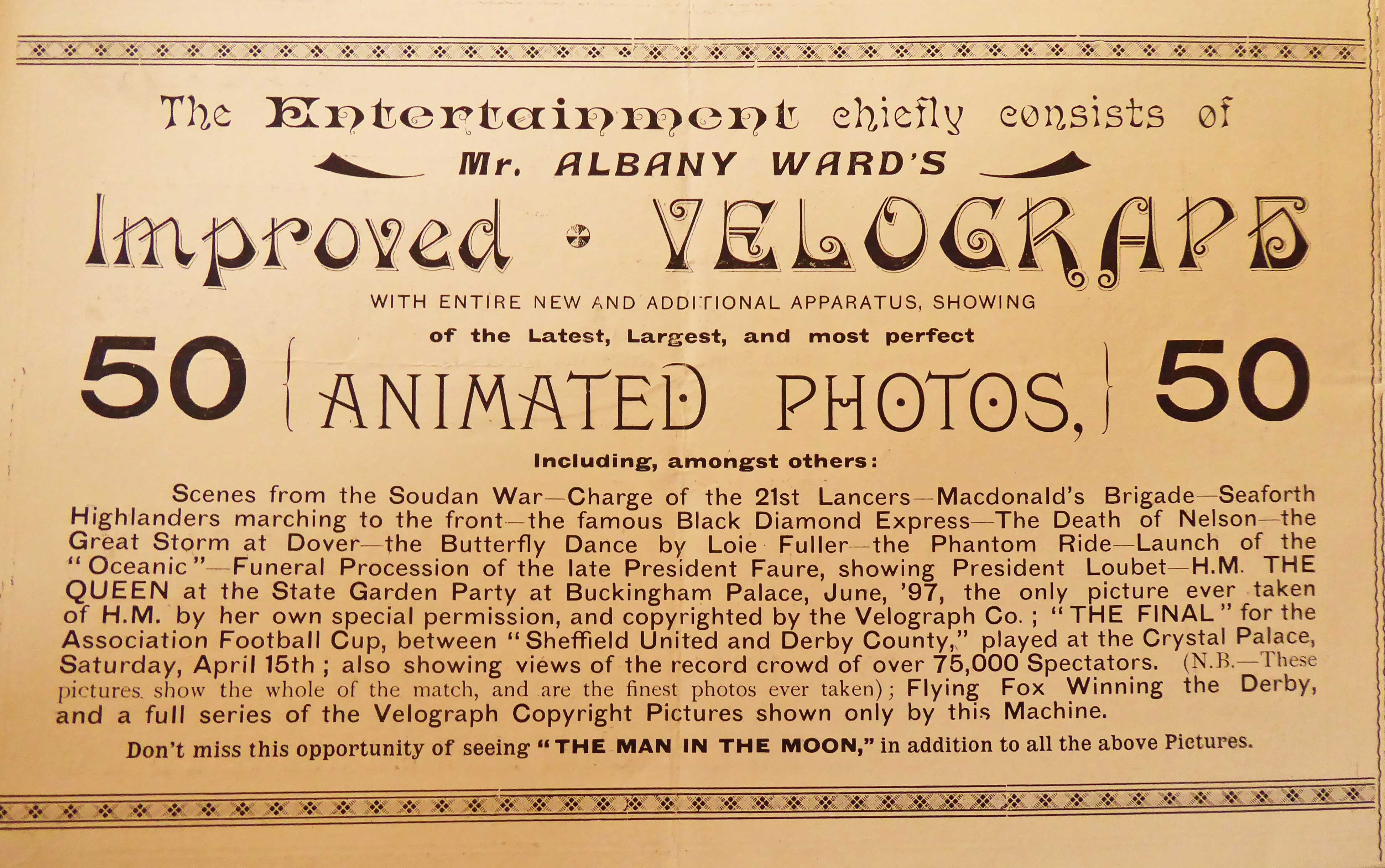
The varied programme includes scenes from the Sudan war, the Cup Final and the Epsom Derby as well as a photograph of Queen Victoria and coverage of the funeral of the French President. At this date, Ward was manager of the Empire Theatre in Cowley Road which became the Palace Cinema in 1912.
[Reference: OCA5/1/C5/2]
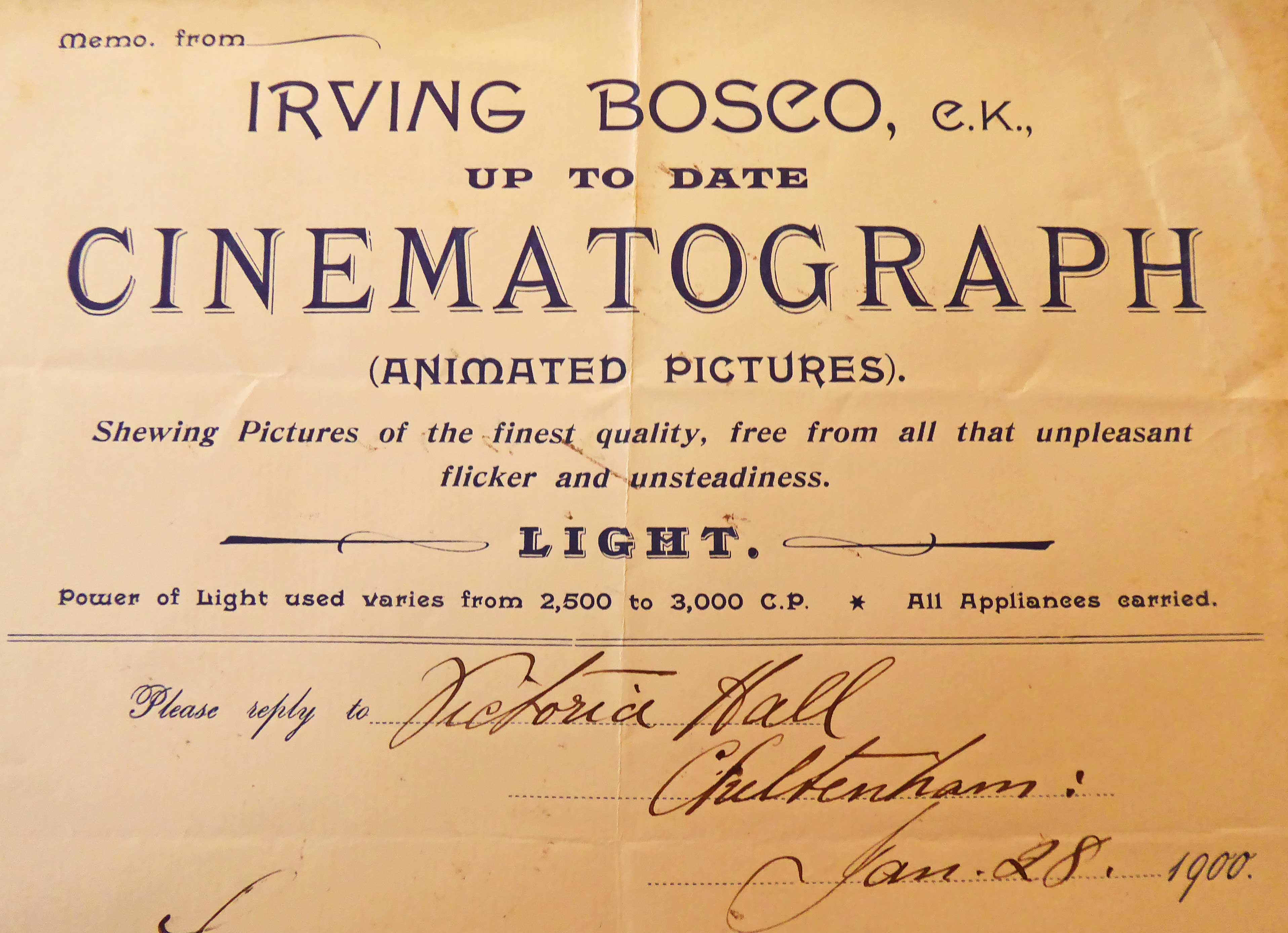
He claimed that his up-to-date Cinematograph was of the finest quality, free from the flicker and unpleasantness which the report of the Clarendon Press screening had noted.
[Reference: OCA5/1/C5/1]
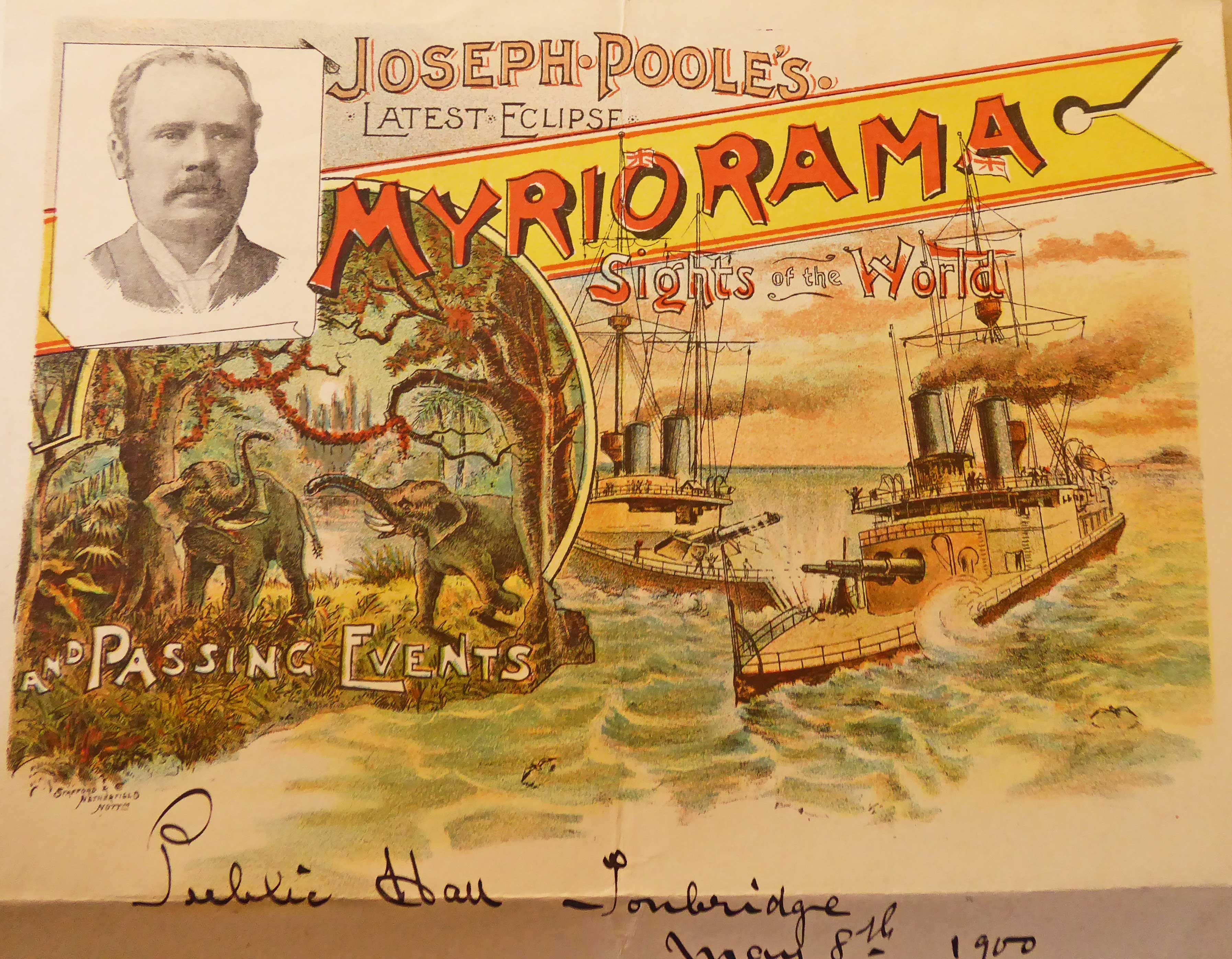
The Royal Navy ships demonstrate imperial pride which early films promoted through news of British successes in the Boer War. Poole’s letter led to a Town Hall booking in August, the first of its kind according to The Oxford Times because the City’s high charges had previously frightened off all comers.
[Reference: OCA5/1/C5/2]
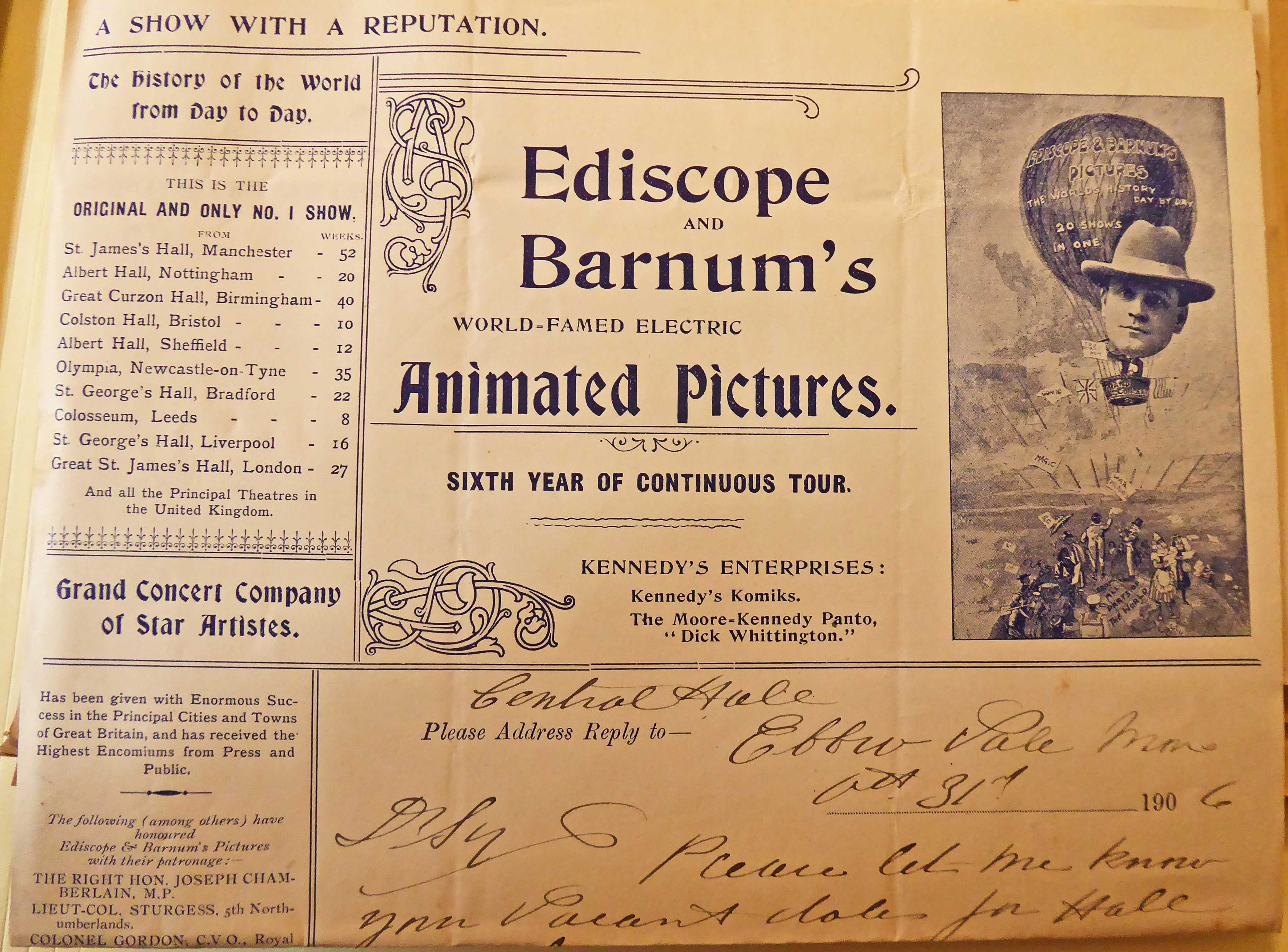
The letter, sent from the Central Hall in Ebbw Vale, was asking for a vacant slot in the Town Hall. The show offers ‘the history of the world from day to day’ as well as ‘A Grand Concert Company of Star Artistes.’
[Reference: OCA5/1/C5/6]
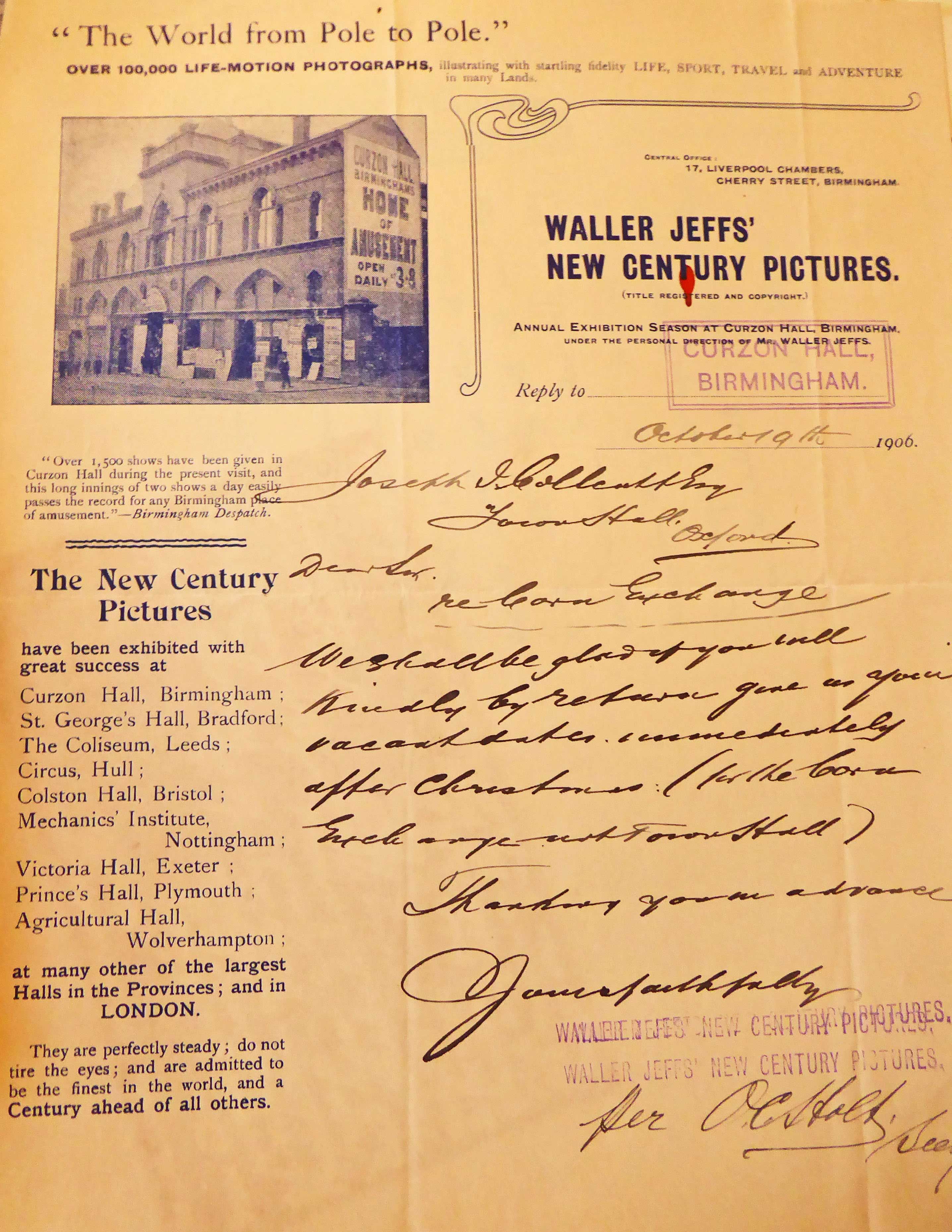
The letterhead suggests that Waller Jeffs operated what was virtually a cinema in Birmingham’s Curzon Hall providing two performances a day. The firm also toured widely, and Holt asks about the availability of the Corn Exchange in the weeks after Christmas.
[Reference: OCA5/1/C5/5]
He confirms that he wishes to book the Town Hall for two weeks beginning on 17 February 1908, adding the request that ‘No animated pictures to be exhibited 4 weeks before my visit.’ Oxford’s New Town Hall features on the list of ‘the largest and best halls’ visited annually by the firm.

[Reference: OCA5/1/C5/8]
Like Pringle, Bromhead makes a point of saying that the hall is not to be let to another picture company before their booking in December, but agrees that West’s Our Navy, presumably a patriotic feature, is not a competitor. The letterhead shows that film had quickly become an international phenomenon.

[Reference: OCA5/1/C5/7]
The firm was using the Chronophone or Talking and Singing Pictures system patented by the Gaumont company. The Chronophone promised ‘Pictures that Talk, Sing, and Live’, but it was another 20 years before synchronised music and speech were added to silent films.

[Reference: OCA5/1/C5/7]
Gooes has discovered that his Easter Week booking will be badly affected because Oxford’s students will be on vacation, and he asks when they will be in town and free to attend the firm’s ‘first class Cinematograph Exhibition.’ Undergraduates were enthusiastic filmgoers, especially at East Oxford venues where they were less likely to be seen by the proctors. Even there they were not entirely safe; T Oliphant of Exeter College was fined £5 and gated for a term in December 1911 for taking a girl to the cinema in Cowley Road and walking about with her.

[Reference: OCA5/1/C5/7]
Ward was now living in Islip and running Imperial Electric Picture Companies from an office in the village. The letterhead claims that this business had been established twelve years earlier in 1896.

[Reference: OCA5/1/C5/9]
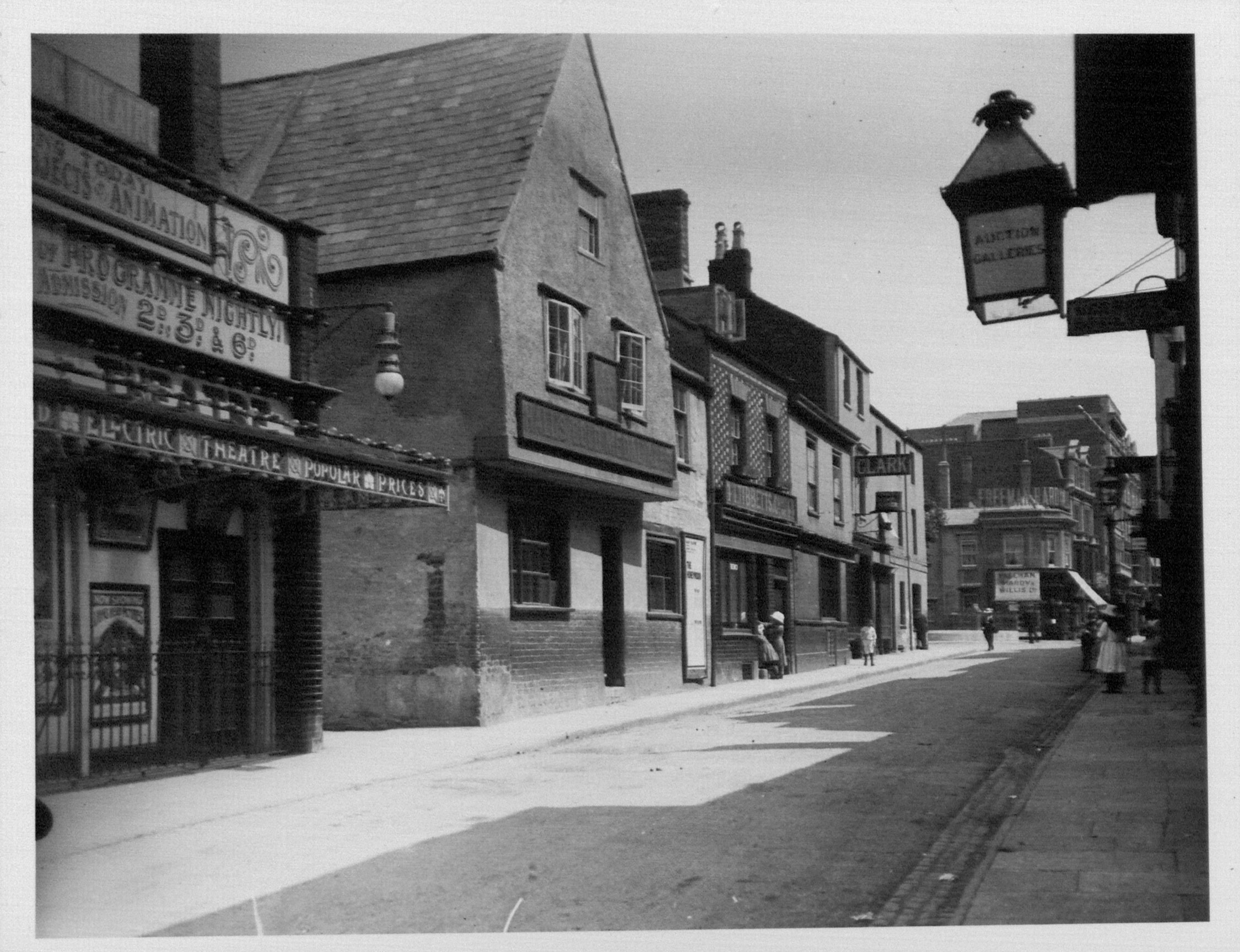
This scheme by the Oxford architect, John R Wilkins, involved converting the former city baths and wash house (1852) into a basic cinema with benches for the audience. The operating room was above the benches at the back, and the screen was between the exit doors at the front. The cinema was Oxford’s first, opening on 26 November 1910 but it closed in about 1923 because of competition from grander cinemas. The building survived until the 1960s, used latterly as the County Council canteen.
Henry Minn’s photograph illustrates a railing and gates in front of the exit doors and reveals admission prices ranging from 2d to 6d. Castle Street was realigned in 1968 and none of the buildings in the foreground survive; the distant shop on the corner of New Inn Hall Street and Queen Street is still recognisable today.
[Reference: POX0149518; Bodl. Minn: 5/19]
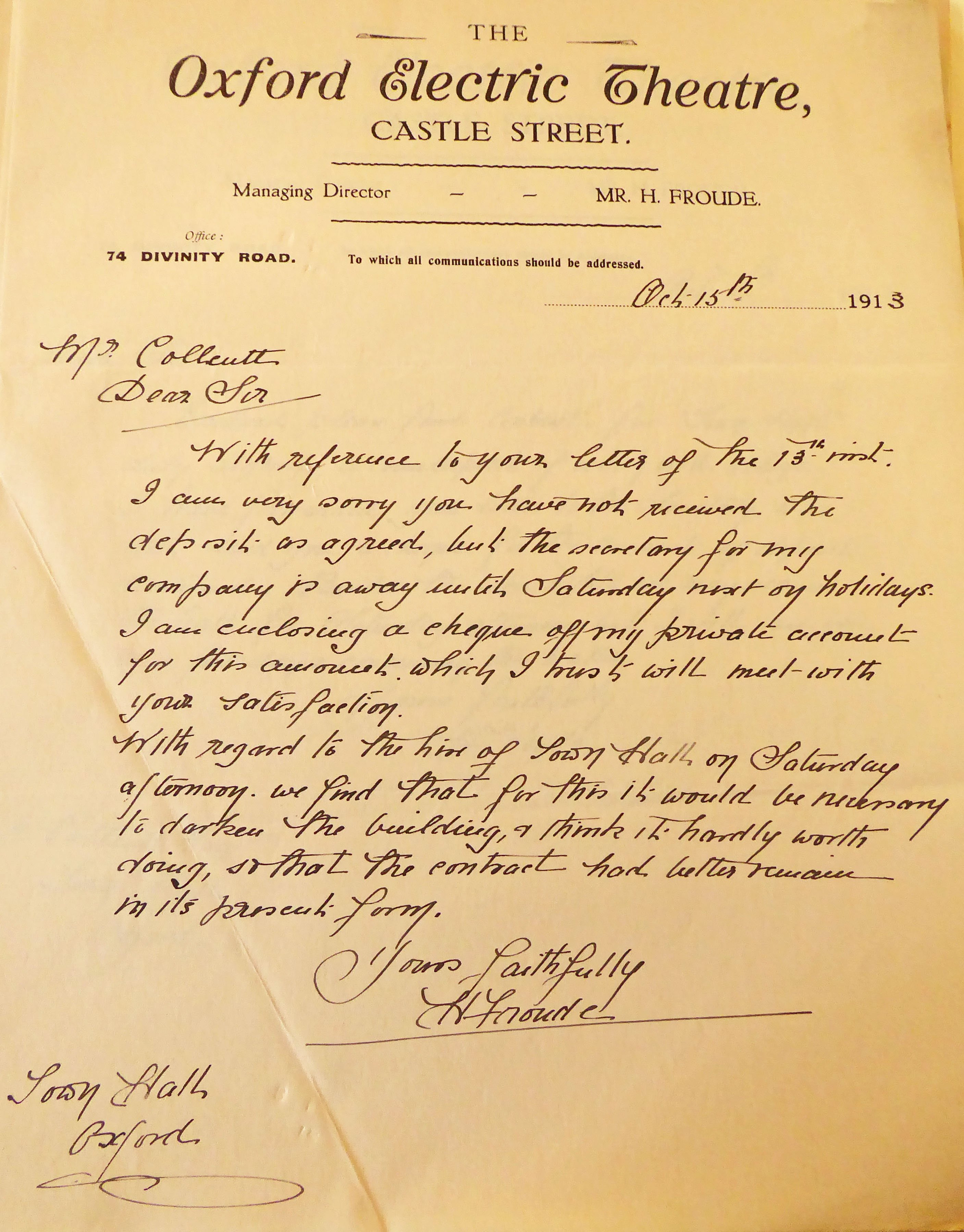
He is enclosing a deposit for the hire of the Town Hall, presumably for a show that was likely to exceed the capacity of his little cinema. He has decided against a Saturday afternoon performance because it would involve going to the trouble of darkening the room.
[Reference: OCA5/1/C5/11]
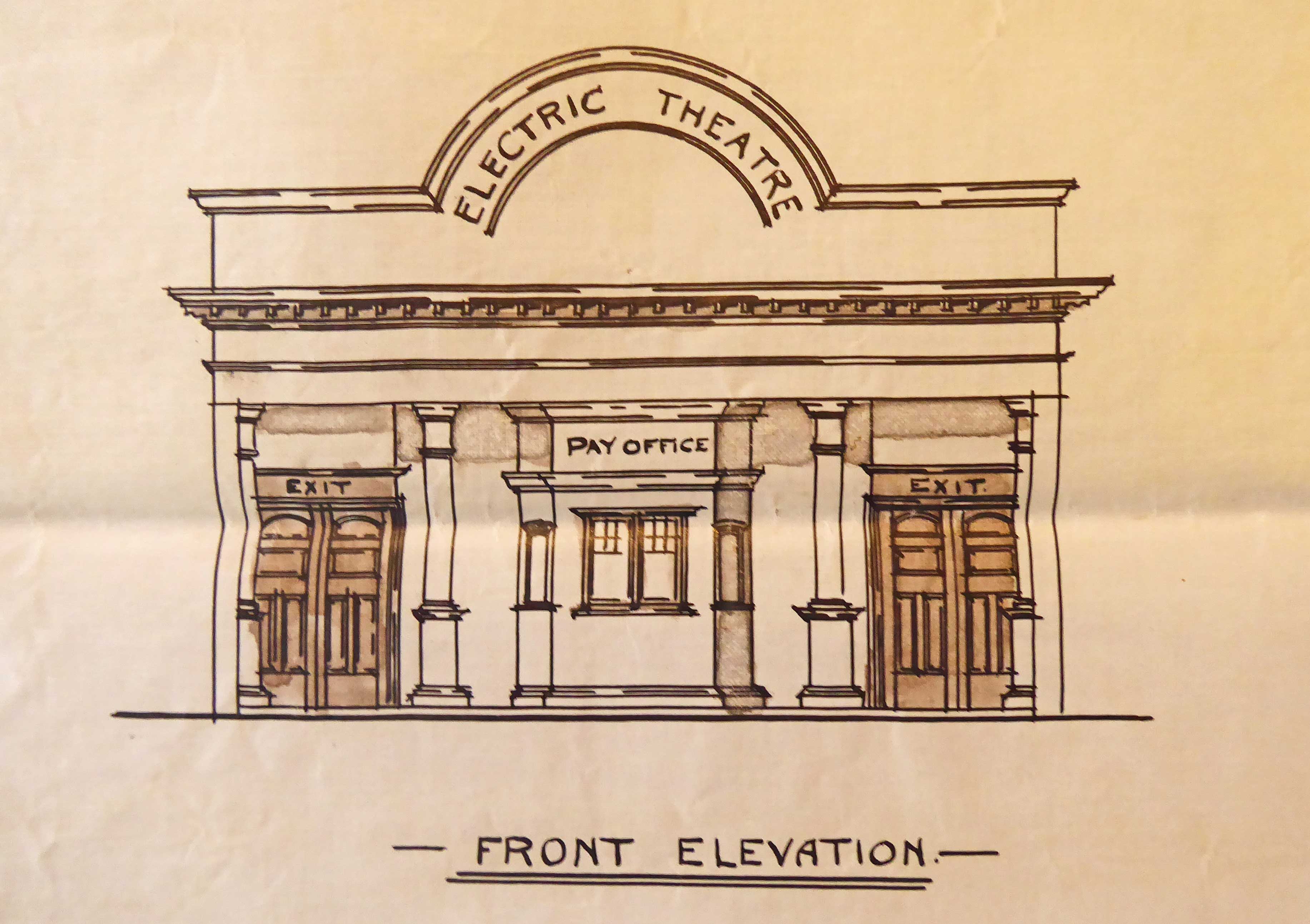
A proposal by the Oxford architect, John R Wilkins, on behalf of Frank Stuart, landlord of the adjacent Elm Tree pub, who clearly saw a cinema as a worthwhile addition to his business. The cinema opened on 25 February 1911, but it faced competition from the nearby Palace Cinema and closed in the early 1920s. The building was used as a furniture store until 1976 when Bill Heine reopened it as a cinema called the Penultimate Picture Palace. He had the frontage adorned by a giant glass fibre sculpture of Al Jolson’s outstretched hands as portrayed in the first talkie The Jazz Singer (1927).
[Reference: POX0080884]
The Electra, designed by Oxford architects, Homer & Lucas, opened on 25 March 1911, and was the third cinema to open in the city in just a few months. As the staff group and the ornate frontage indicate, the Electra was both larger and more comfortable than the two earlier cinemas. It was slotted in between the Maypole Dairy Ltd., and Freeman, Hardy & Willis’ shoe shop on the south side of the street; Marks & Spencer store now occupies the site.

[Reference: POX0137616]
Bill Heine’s Penultimate Picture Palace has evolved into the Ultimate, and this photograph of the little-altered front elevation with its central pay box was taken just over a century after the cinema opened. It was listed Grade II as a building of architectural or historical interest in 1994 and today forms a tangible link with the early years of film in Oxford.

[Reference: POX0563655]
Posted by: Malcolm Graham, Volunteer
