
Reference: NQ3/1/A1/7
20 April 2023
In our January blog guest writer, Simon Burbidge, looked at using Quaker records for family history research. In this blog he uses Quaker records to explore the history of the Whiting family of Witney.
Reference: NQ3/1/A1/7
Some records relating to the William Whiting of Witney, his son Thomas and other members of the family illustrate the amount of additional information that can be found within the Quaker records held at Oxfordshire History Centre and at the National Archives. It not only enables a picture to be built of the lives of the family but also opens up further areas of research
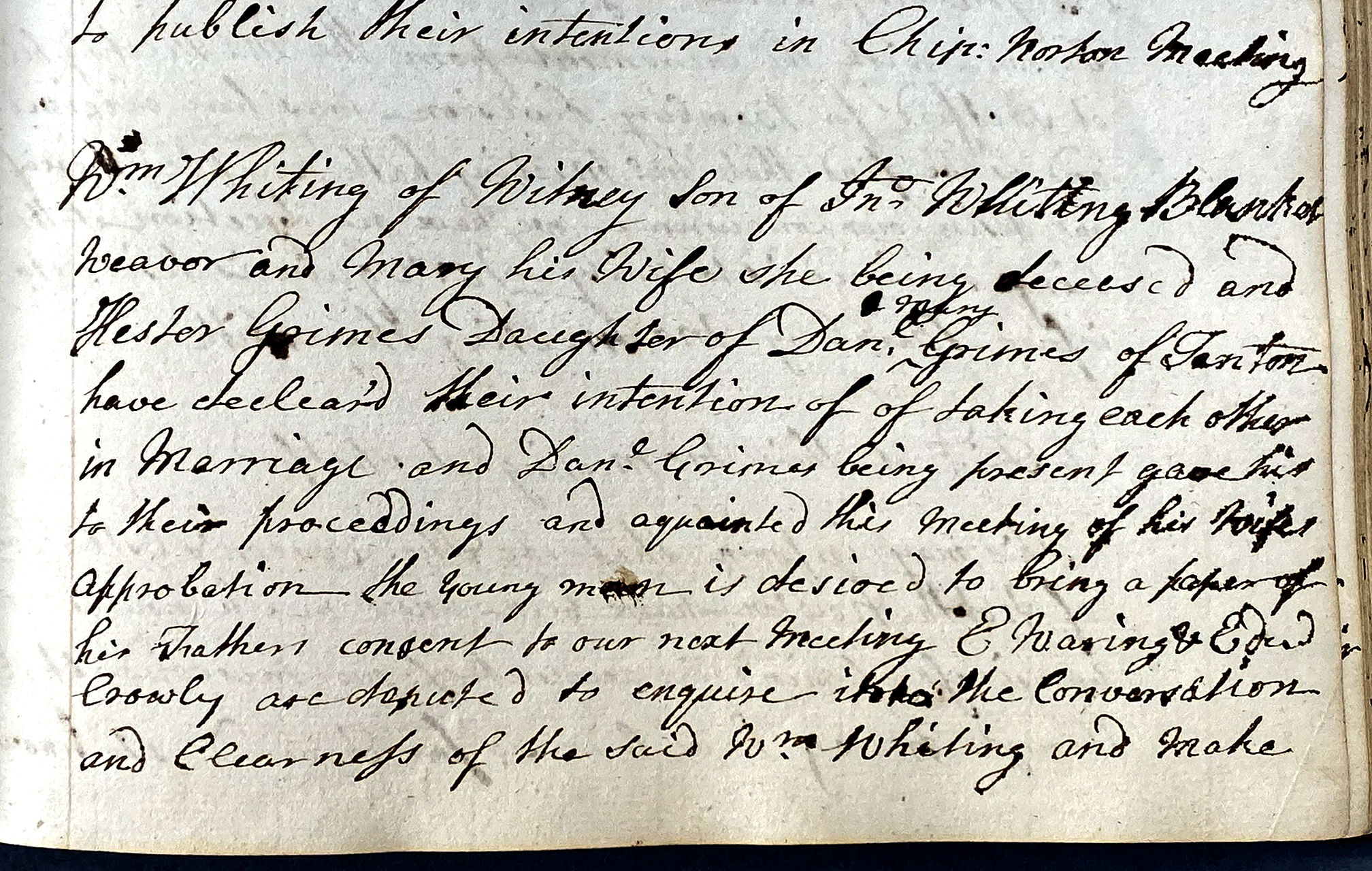
William was born in about 1734 in Witney, the son of John Whiting, a blanket weaver. In 1763 he married Esther Grimes from the village of Tainton, near Burford. The Minute Book of the Witney Monthly Meeting (reference NQ3/1/A1), refers to their marriage as follows:
Witney Monthly Meeting 9th May 1763: ‘Wm Whiting of Witney, son of Jno Whiting Blanket Weaver and Mary his wife she being deceased and Hester Grimes daughter of Daniel & Mary Grimes of Tainton have declared their intention of taking each other in marriage and Daniel Grimes being present gave his approbation - the young man is desired to bring a paper of his father’s consent to our next meeting. E Waring and Edwd Crowley are deputed to enquire into the conversation and clearness of the said Wm Whiting and make report thereof to our next meeting and one of them is desired to publish their intentions in Witney Meeting. Thos Huntley is desired to do it at Burford.’
Reference: NQ3/1/A1/4
The following meeting recorded the following:
Witney Monthly Meeting 13th June 1763: ‘Wm Whiting and Hester Grimes having declared their intention a second time before this meeting and John Whiting been present gave his consent report is made by Edwd Crowley that enquiry have been made respecting his clearness and conversation and nothing appearing (sic) to obstruct their proceeding this meeting gives them leave to accomplish their marriage at what convenient time they think proper.’

Reference: NQ3/1/A1/4
These entries give far more information than would be available in the equivalent parish register of the time.
Thomas Whiting, William and Esther’s first child was born in 1764 as this entry recording his and his siblings’ births in the Register of births of the Witney Monthly Meeting held at The National Archives shows.

Reference: RG6/1378 Folio 40
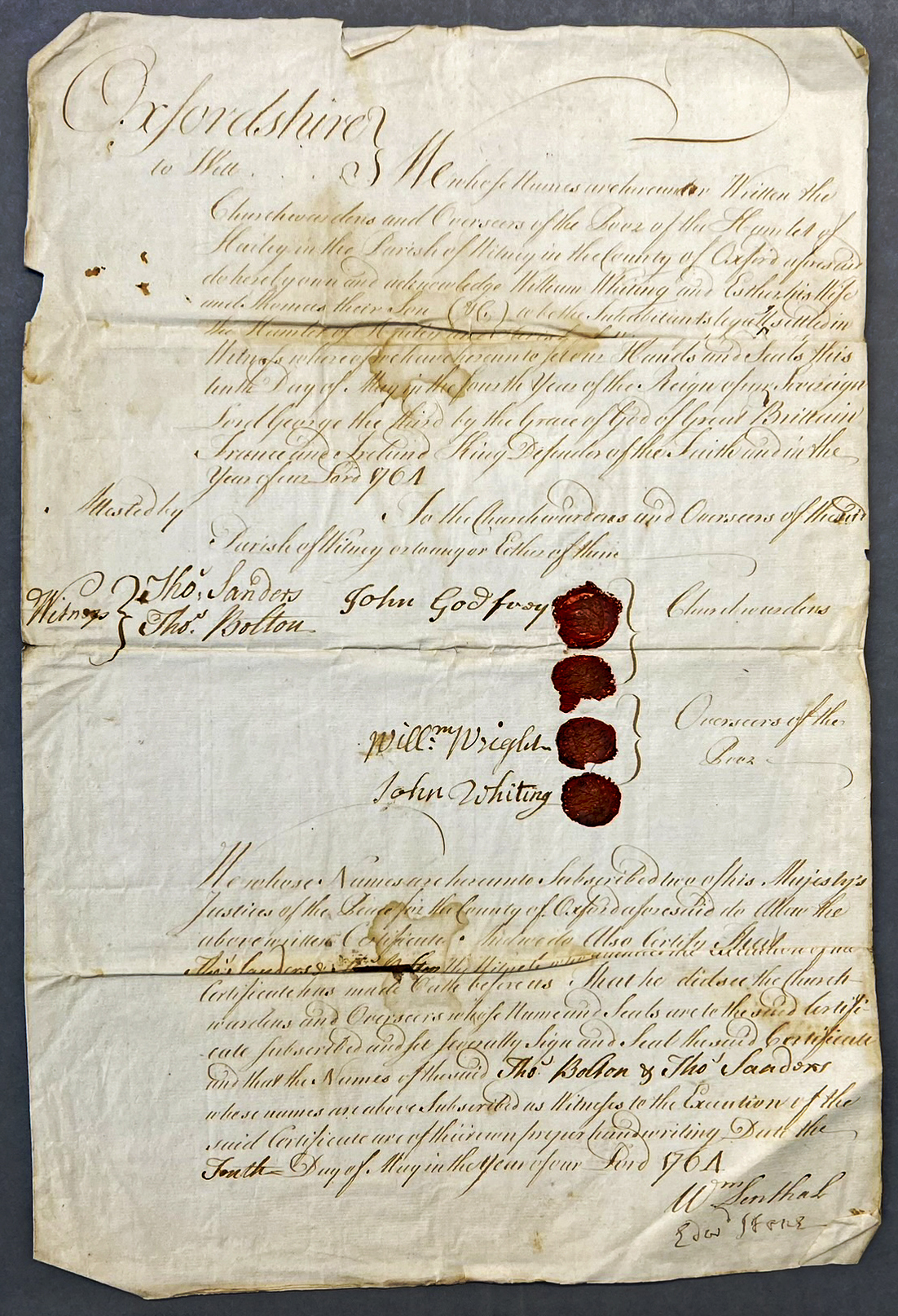
Shortly after Thomas’ birth the family moved from the hamlet of Hailey that lies to the north of Witney into the town itself as this settlement certificate shows.
Reference: PAR295/5/A3/200
Both Thomas and his father, William were blanket weavers and members of the Company of Blanket Weavers in Witney whose records are held at the Oxfordshire History Centre.
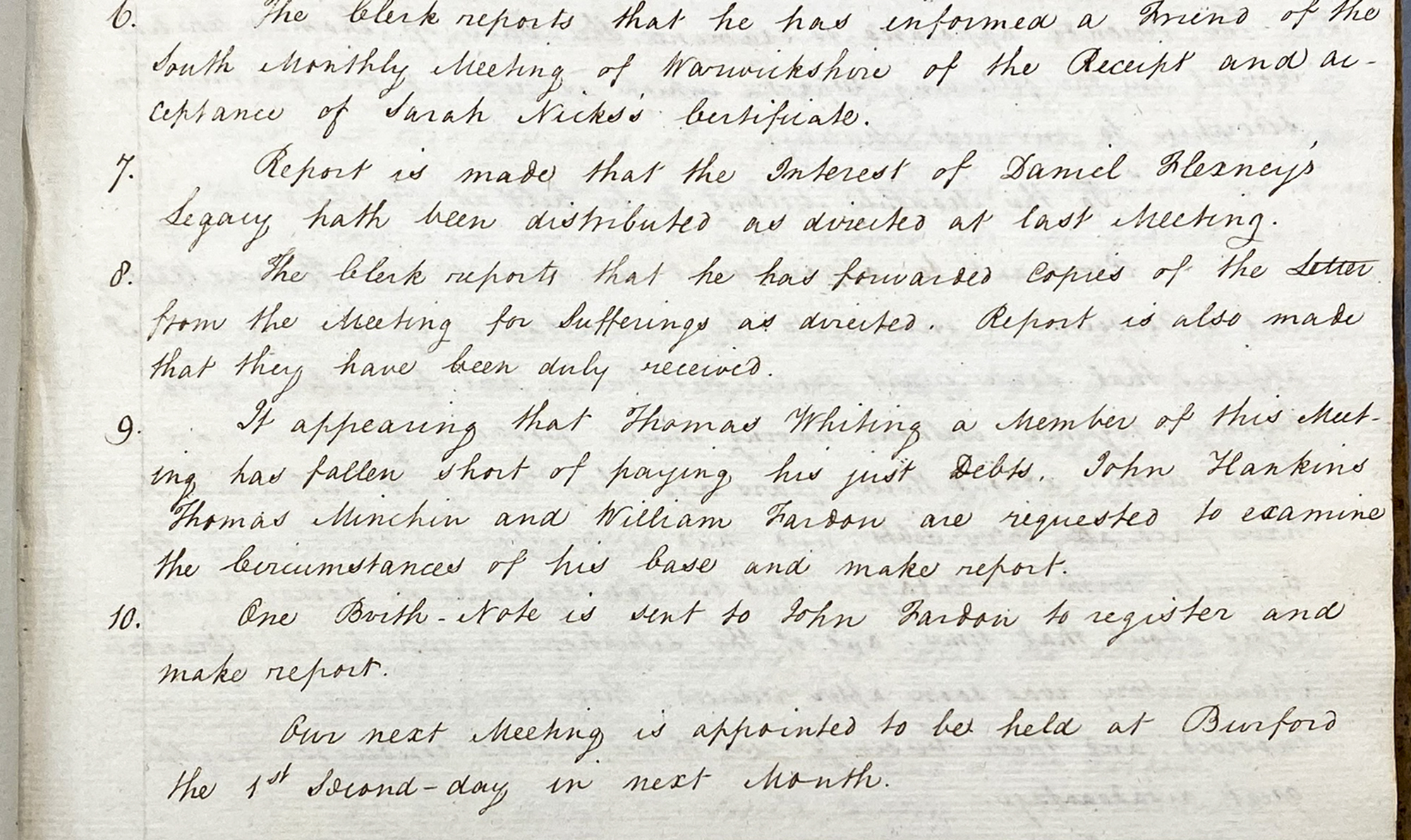
The minutes of the Witney Monthly Meeting of 13th March 1797 contain the following entry:
It appearing that Thomas Whiting a member of this meeting has fallen short of paying his just debts. John Hankins, Thomas Minchin and William Fardon are requested to examine the circumstances of his case and make report
Reference: NQ3/1/A1/8
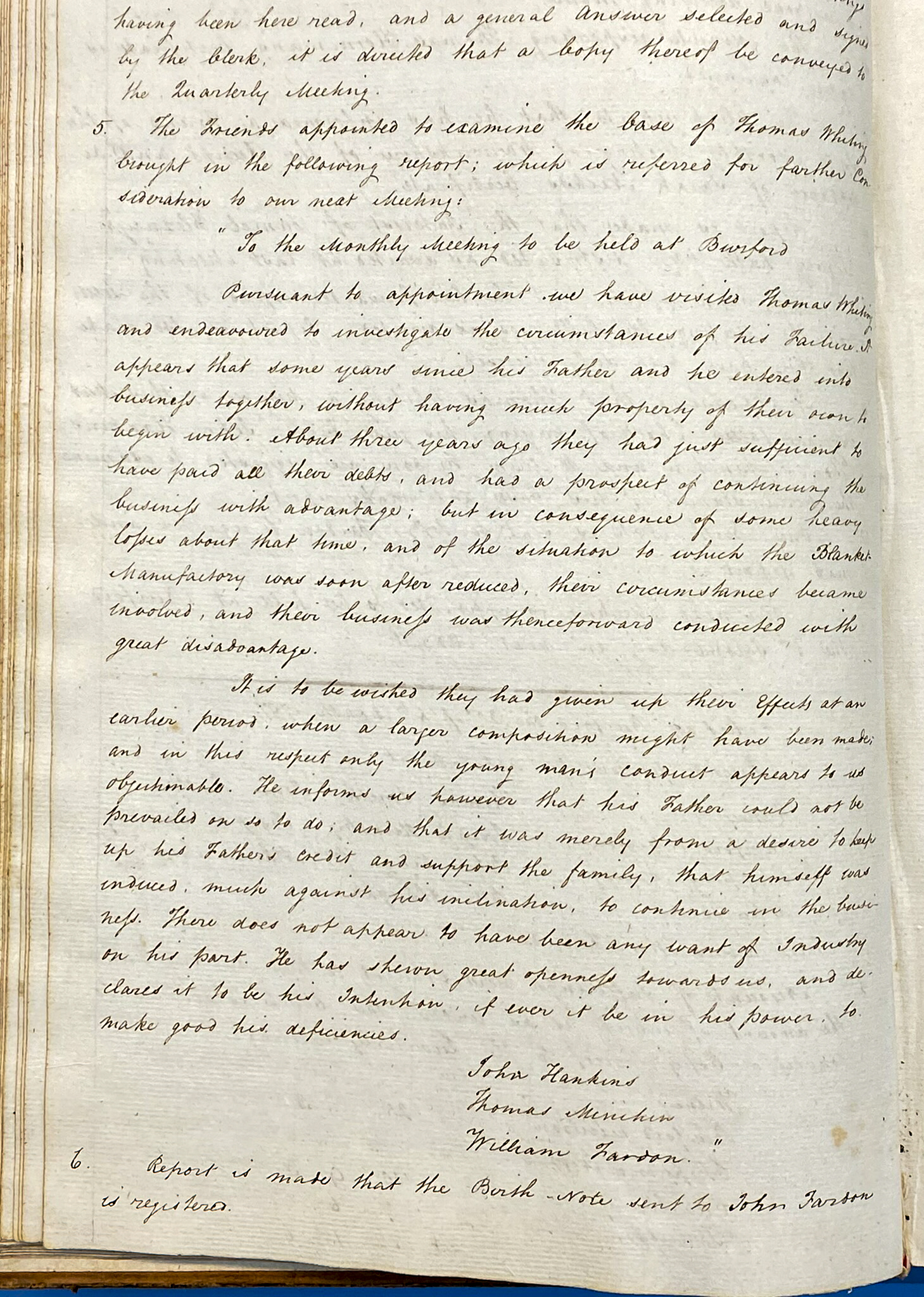
They reported to the 3rd April 1797 meeting:
To the Monthly Meeting to be held at Burford. Pursuant to appointment we have visited Thomas Whiting and endeavoured to investigate the circumstances of his failure. It appears that some years since his Father and he entered into business together without having much property of their own to begin with. About three years ago they had just sufficient to have paid all their debts and had a prospect of continuing the business with advantage but in consequence of some heavy losses about that time, and of the situation the Blanket Manufactory was soon after reduced, their circumstances became involved and their business was thenceforward conducted with great disadvantage.
It is to be wished they had given up their effects at an earlier period when a larger composition might have been made and in this respect only the young man’s conduct appears to us objectionable. He informs us however that his father could not be prevailed on so to do and that it was merely from a desire to keep up his Father’s credit and support the family that himself was induced much against his inclination to continue in the business. There does not appear to have been any want of industry on his part. He has shown great openness towards us and declared it to be his intention if ever it be in his power to make good his deficiencies.
Reference: NQ3/1/A1/8
The August meeting found this report satisfactory and the matter was closed
There are a series of entries in the Witney Monthly Meeting minutes some years previously relating to a drink problem of William’s:
11th December 1786 meeting:
The Friends of Witney by a minute of their Preparative Meeting informed us that the conduct of William Whiting continues to be reproachful in drinking to excess notwithstanding the former advice given him.
Reference: NQ3/1/A1/7
Fifteen months later the 10th March 1788 meeting noted:
By report from a Friend of Witney it appears that the conduct of William Whiting still continues to be reproachful - this meeting having long waited in hopes of an amendment in his life and conversation agreeable to his own request - are now of the judgement it is their incumbent duty to testify against him - and the Clerk is desired to draw up a Testimony of Denial and bring for the approbation of Next meeting.
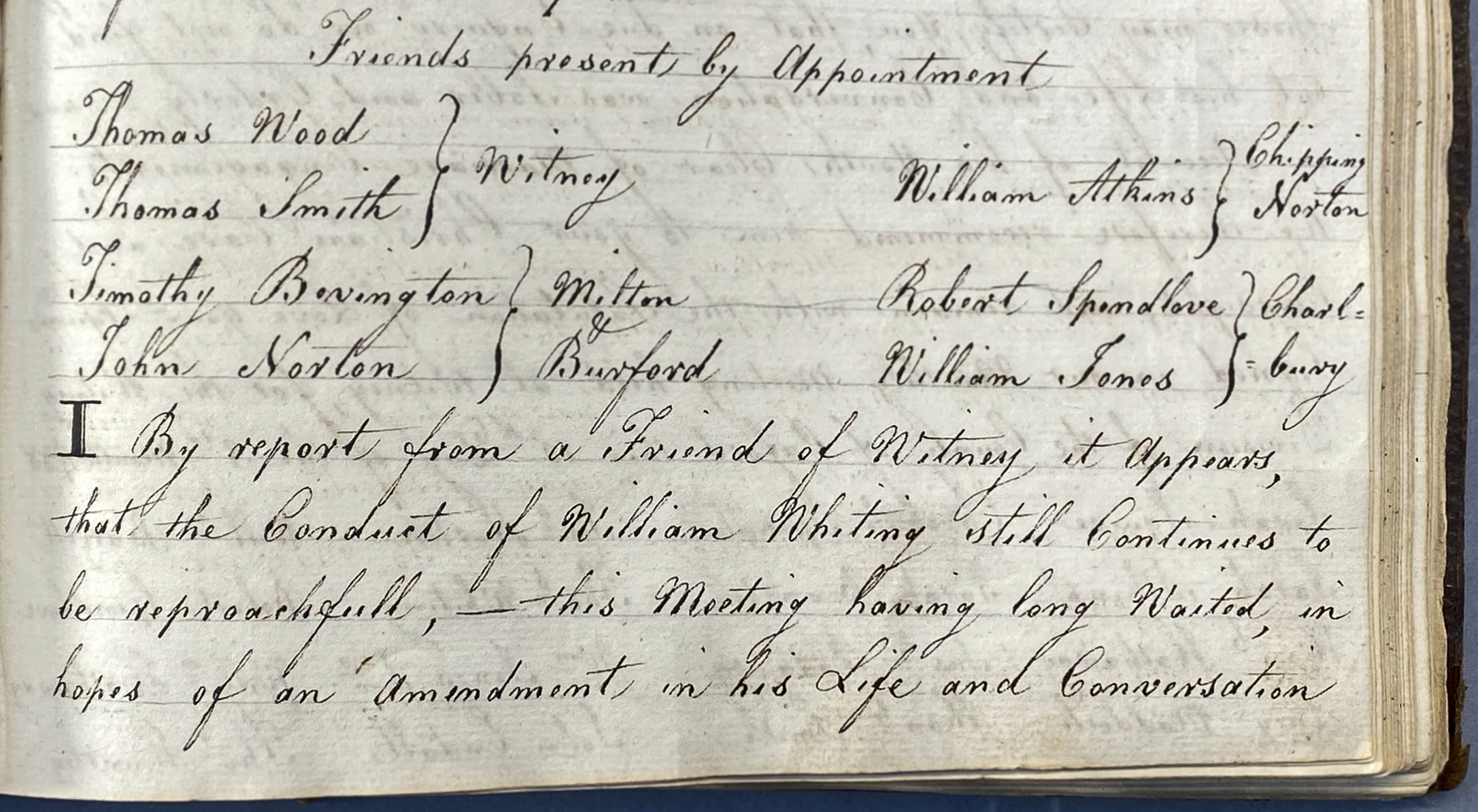
Reference: NQ3/1/A1/7
The 7th April 1788 meeting produced the following denial.
Whereas the conduct of William Whiting a member of this meeting hath for a long time been very reproachful in drinking to excess likewise involving himself in trade to the great injury of his creditors as well as his own reputation - and having been visited and revisited by deputation from this meeting and advised to the contrary. This meeting having also had long forbearance with him desiring an amendment in his life and conversation, without the desired effect - are now of the judgement that it is a duty incumbent on us to testify against him and to declare we cannot any longer own him to be a member of our society - Nevertheless we sincerely desire he may come to be fully sensible of his errors - by returning by repentance and amendment of his life so as to be restored again into membership.

Reference: NQ3/1/A1/7
The latter minute suggests that he had had business problems. Were these the result of his drinking or the cause of it? Further research shows that his business had run into significant difficulties in 1785/6 because Oxfordshire History Centre holds a Deed of Arrangement dated 16th March 1786 in which he is signing over all his property and goods to his creditors save £30 of bedding and household goods for the use of himself, his wife Esther and his children. At the foot of the indenture his creditors (or their nominees) have signed themselves and have affixed their seals against the amounts owing to them.

Reference: DA/I/V/10
The total amount was very substantial indeed totalling £974 7s 2d
William managed to continue in business because the Court Book of the Company of Weavers held at Oxfordshire History Centre has an entry on 21st April 1795 stating that Edward Seely, (William's late apprentice) ‘was admitted a member of the Company and paid the Clerk's fees and those to the Company and was duly sworn’. Edward must have taken Seely as his apprentice sometime after his Deed of Arrangement.

Reference: B1/1/A/7
The Company of Weavers maintained strict quality control over the blankets being woven and on 11th August 1795 William and son (Thomas?) were ‘fined 20s for making one stockful of stripes four inches too wide which he paid down and the same is remitted to two shillings and six pence‘.
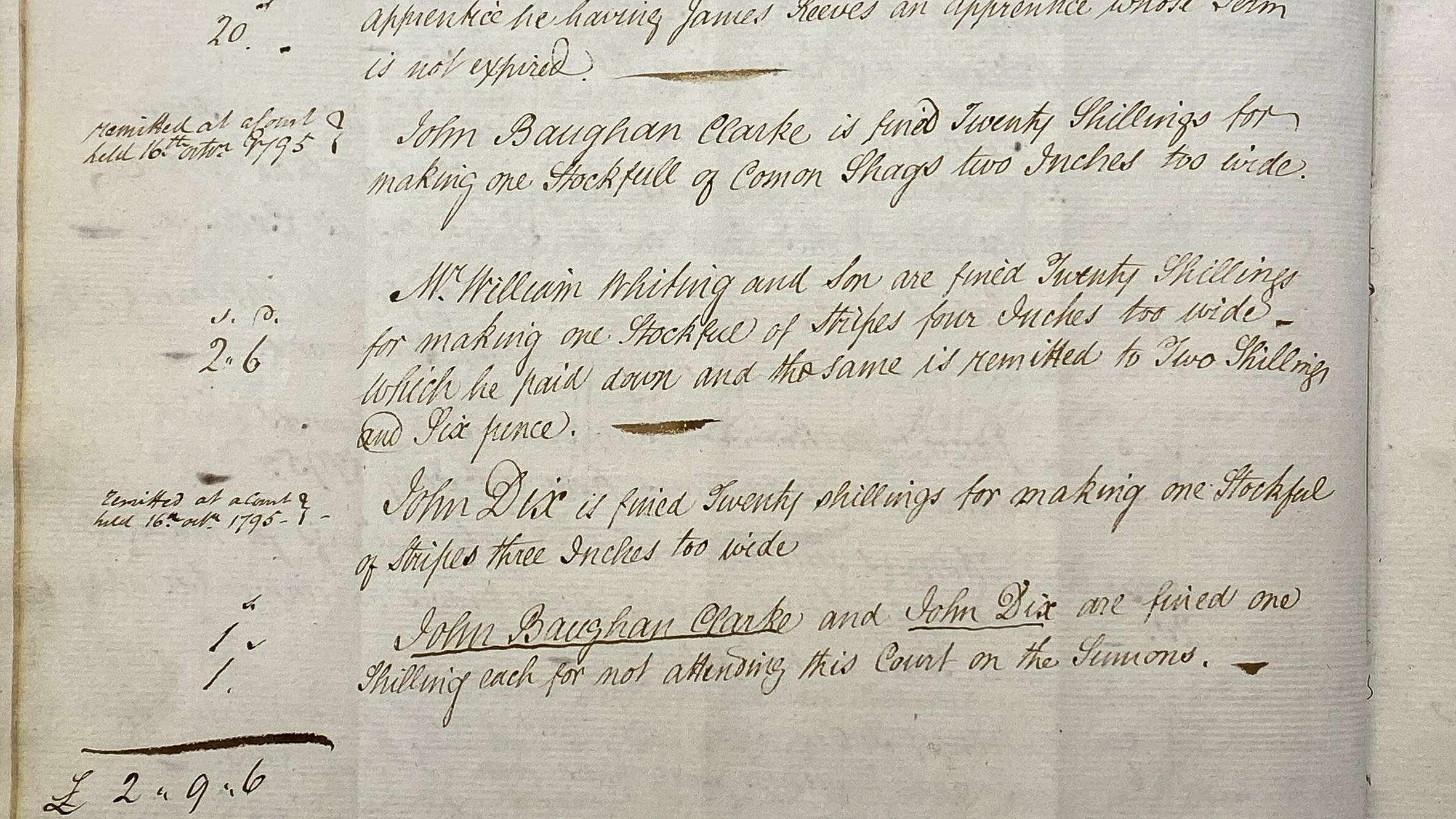
Reference: B1/1/A/7
William must again have run into problems because two further entries in the Court Book are as follows:
On 25th October 1796 the entry read: ‘Richard George late apprentice to William Whiting was turned over to serve the remainder of his term of apprenticeship with Mr Jas Long'.
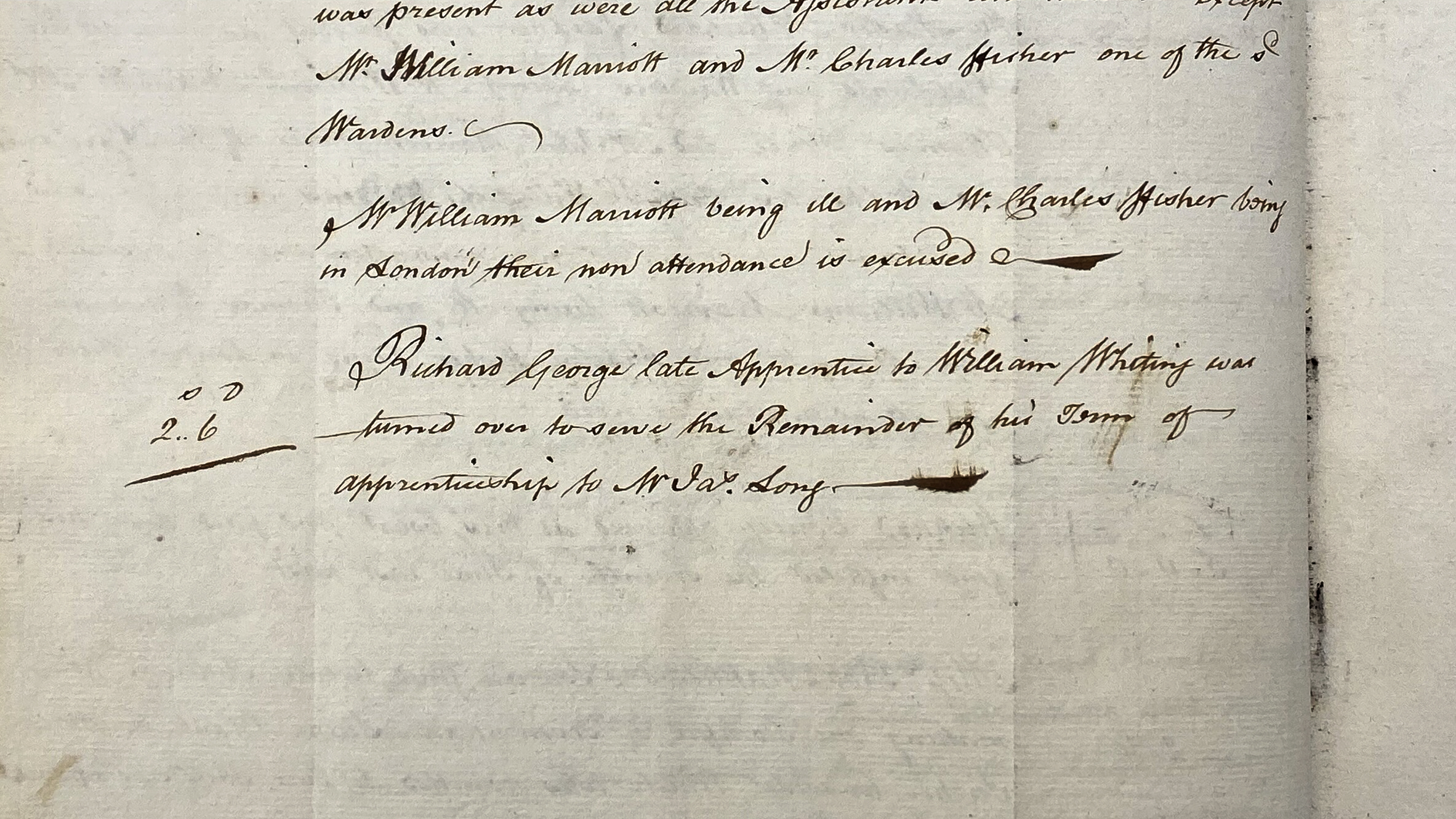
Reference: B1/1/A/7
On 21st December 1796 another entry referred to 'William Whiting jun apprentice to William Whiting senr turned over to serve the remainder of his term of apprenticeship to Richard Edwards'.
Turning over apprentices was very unusual and having to turn over his own son indicates how bad things had become for William and Thomas.
Jackson’s Oxford Journal 3rd December 1796 contains a possible explanation for the turnings over.
The Creditors of Wm. WHITING and SON, of Witney, Oxfordshire, Blanket Weavers, are requested to send the Particulars of their respective Demands to Messrs. John Shorter, Richard Collier, and J. Biggers, of Witney aforesaid, on or before the 22nd inst. to enable the Trustees to adjust the Dividend of their Estate and Effects. December 1st, 1796.
An entry in the Court Book of the Company of Weavers on 28th October 1800 seems to indicate that even after all of these issues William managed to resurrect his business as it records him taking his son, Daniel as an apprentice.
'Daniel Whiting son of William Whiting bod apprent to his said father for seven years from Aug 29 last'.
Also Jackson’s Oxford Journal dated 18th March 1809 has an advertisement regarding the estate of Ann Brooks
‘Two DWELLING HOUSES, adjoining together, situate in West End, Witney, in the respective occupations of William Whiting and Thomas Layte, tenants at will, with brew-house, stable, and other out-houses, yard and garden; also a WEAVING SHOP, WOOL LOFTS, and other extensive buildings adapted to the Blanket Manufacture.’
William died on 9th March 1812 and was buried at Witney on the 15th. He obviously hadn’t been reinstated with the Friends although he was buried in their burial ground because there is an entry in the Register of Burials for the Quarterly Meeting of Berkshire and Oxfordshire at The National Archives but it is annotated ‘not a member’.
Register of Burials for the Quarterly Meeting of Berkshire and Oxfordshire from 1808 to 1837
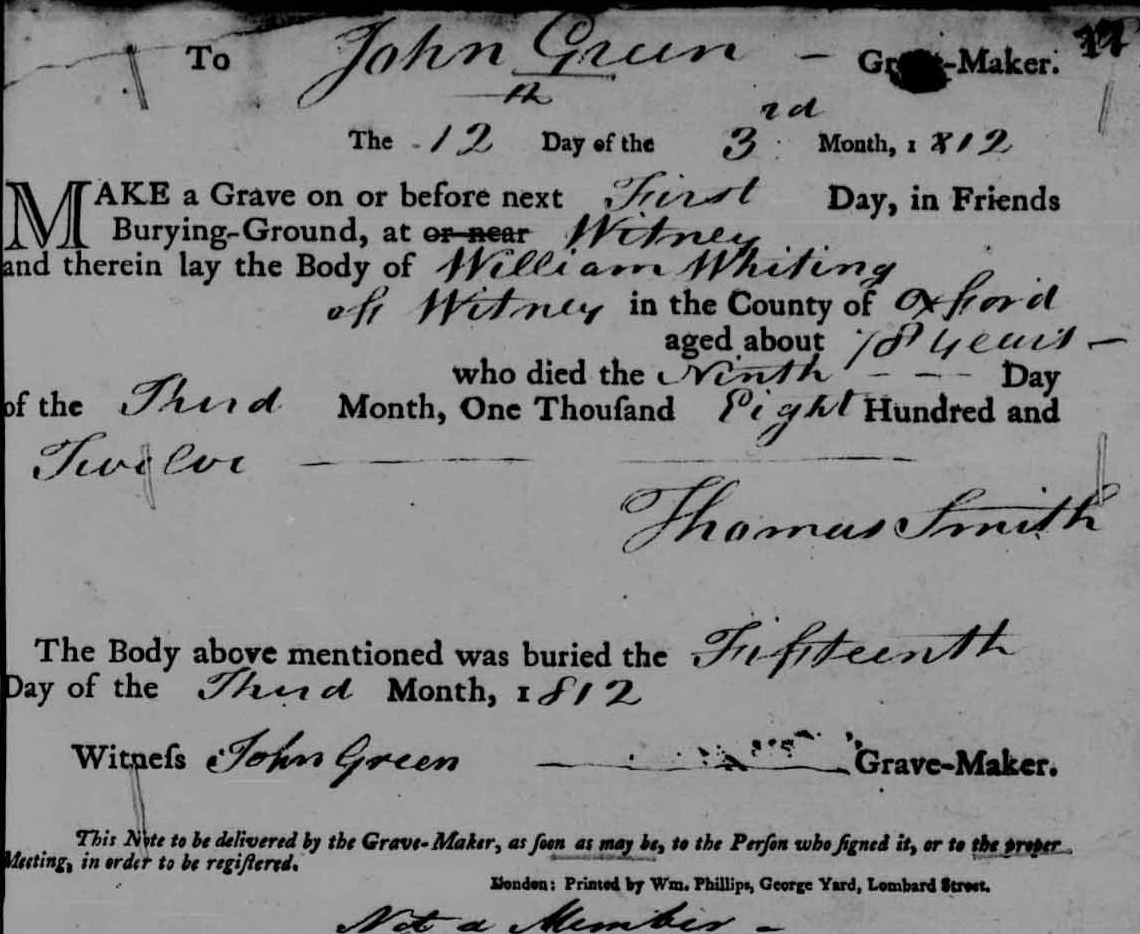
Reference: RG6/108 Folio 17
Just over two years after William and Thomas’ business had failed Thomas appears in the minutes of the Witney Monthly Meeting. On 1st April 1799 the following entry was recorded:
Report is made from Witney Preparatory Meeting that Thos Whiting has been married by a priest contrary to the rules of our Society; the Clerk is therefore desired to draw up a Testimony of Denial against him and bring to our next meeting.

Reference: NQ3/1/A1/8
From the 6th May meeting:
The following Testimony of Denial against Thos Whiting of Witney was here read, approved and signed. Wm Barrett & Jno Hawkins are requested to read it to him and return to this meeting.
“Thomas Whiting of Witney having been lately married by a priest contrary to the rules of our Society and his conduct in other respects having been very reproachful we hereby declare we cannot have unity with him as a member amongst us; nevertheless wish he may be brought to a right sense of his misconduct.
And from the 10th June meeting:
The Friends appointed have returned the Testimony of Denial against Thos Whiting having read it to him
Thomas had in fact been married Mary Heydon, another Quaker from Farnborough in Warwickshire by licence at St Cross, Holywell in Oxford on 15th March.
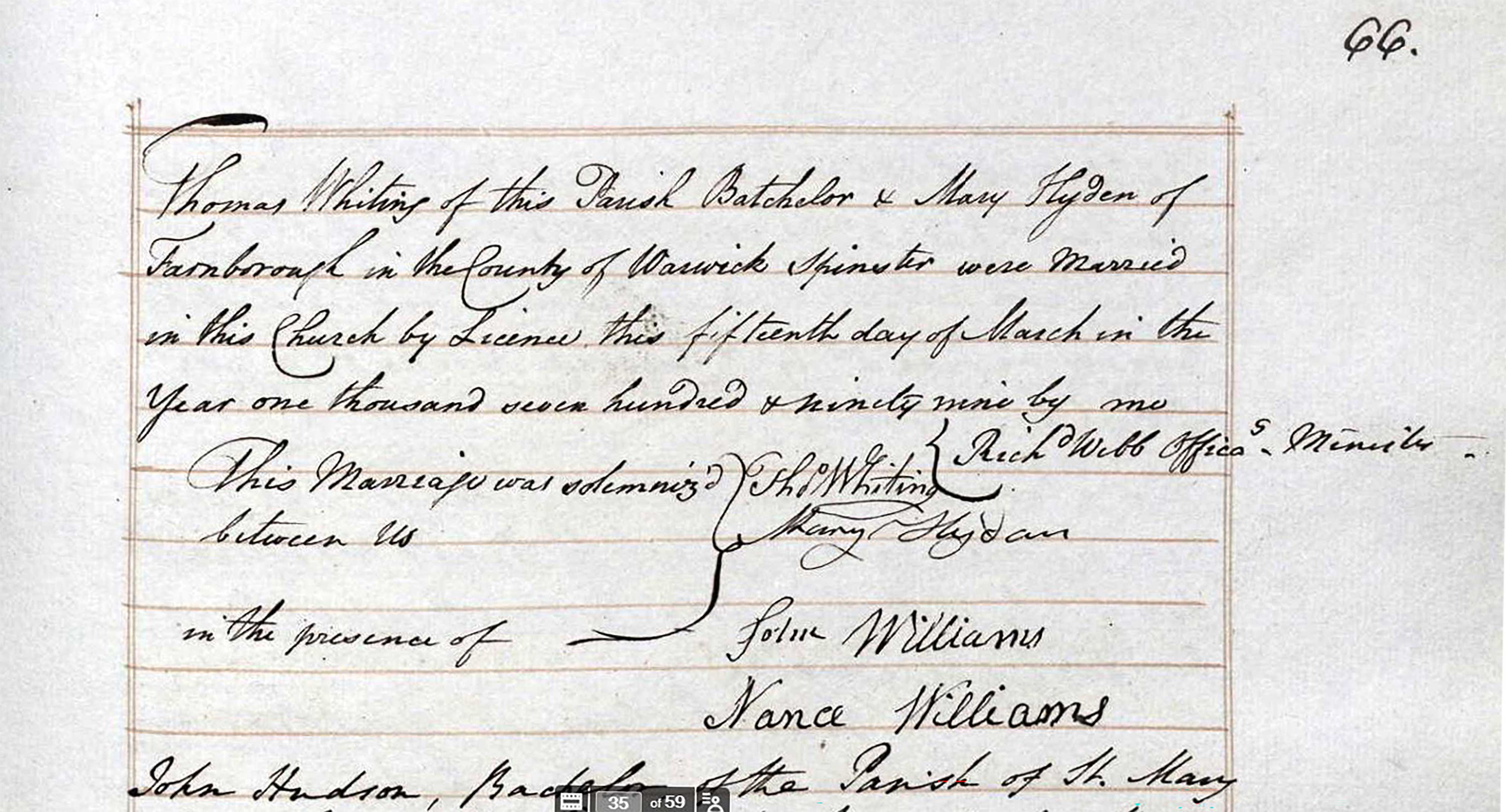
Reference: PAR199/1/R3/2
The marriage bond held at Oxfordshire History Centre is for £200 and shows that Thomas was a weaver by profession and he stated that he had been resident in the parish of Holywell for four weeks.
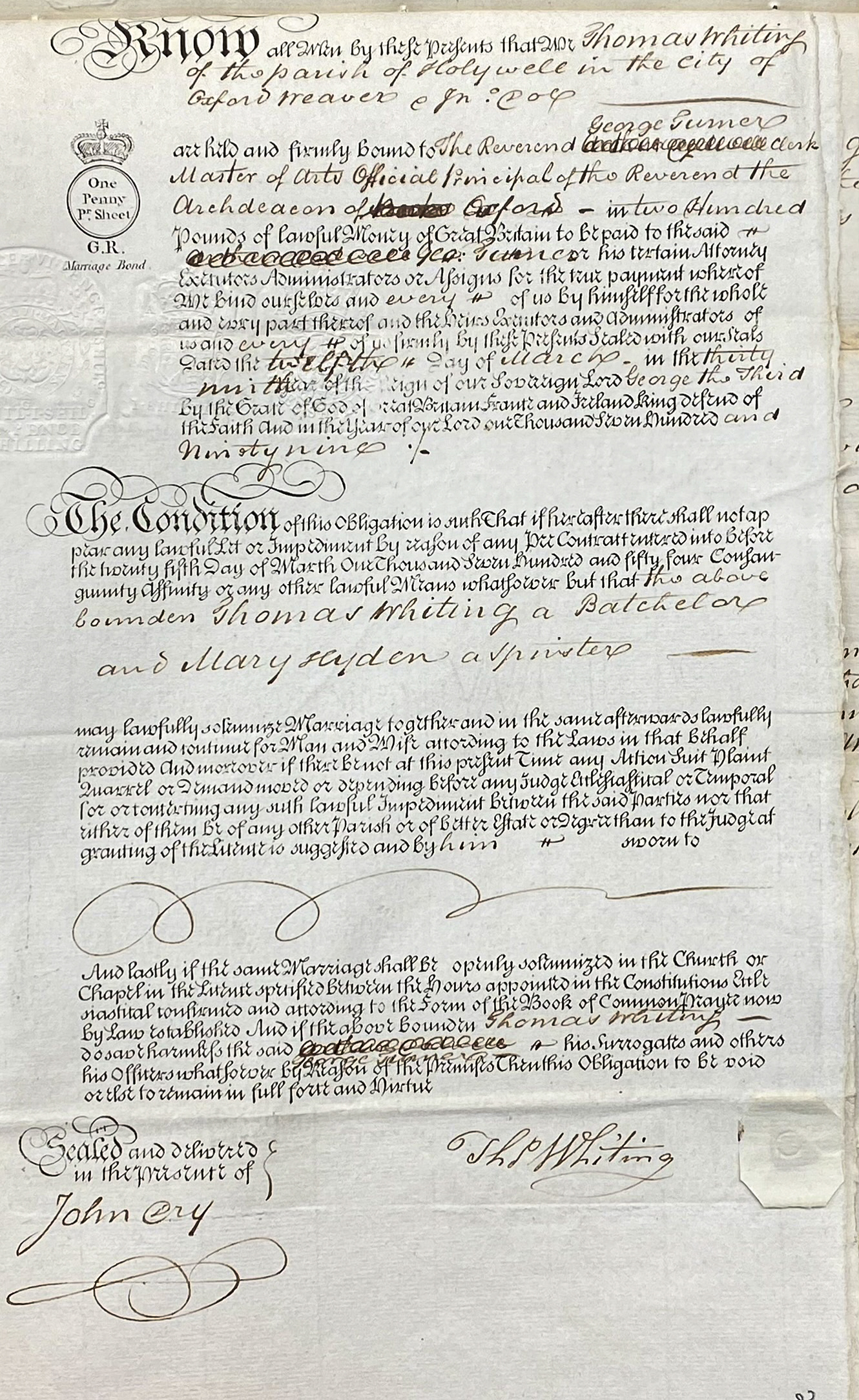
Reference: MSS.ARCHD.OXON/c587
Mary must have been heavily pregnant at the time of their marriage because a daughter, Emma was born just over a month after the wedding. Perhaps this explains why they chose to marry in church. Perhaps they viewed the disapproval that this would cause as a lesser problem than that which would have arisen if they had sought permission to marry from the monthly meeting, permission which would surely have been refused.
Thomas and family must have moved from Witney to Reading around the turn of the century because that was where a second daughter, Sarah was born, on the second of January 1801. He adopted another trade becoming an umbrella maker.
Although they had been disowned by the Witney Monthly Meeting, Thomas and Mary registered Emma’s birth with the Reading Monthly Meeting according to the Register of Births held at the National Archives (RG6/32 Folio 3). They obviously felt the need to have their children's births registered by the Quakers because there are various birth entries in RG6 that refer to the 'parents not being members'.
There is also a burial note in the records at the National Archives dated 2nd December 1812 referring to Thomas (RG6/33 Folio 20). The Reading Mercury dated 7th December 1812 contained a brief obituary - 'This week died, deeply lamented, Mr Whiting, Umbrella manufacturer of this town.'
Amongst the many other references to the family there are entries in the Witney Monthly Meeting Minute Book referring to another of William’s sons, Daniel and his schooling.
On 17th October 1796: ‘Daniel Whiting a lad of Witney stands in need of a little more education than he has at present the consideration whereof is referred to next meeting but it is the desire of this meeting that the Friends of Witney see that he is kept in school in the meantime.’

Reference: NQ3/1/A1/8
Another on 14th November 1796: ‘This meeting after some consideration requests the Friends of Witney to see that Danl Whiting is put to a suitable school in the place where he lives.’
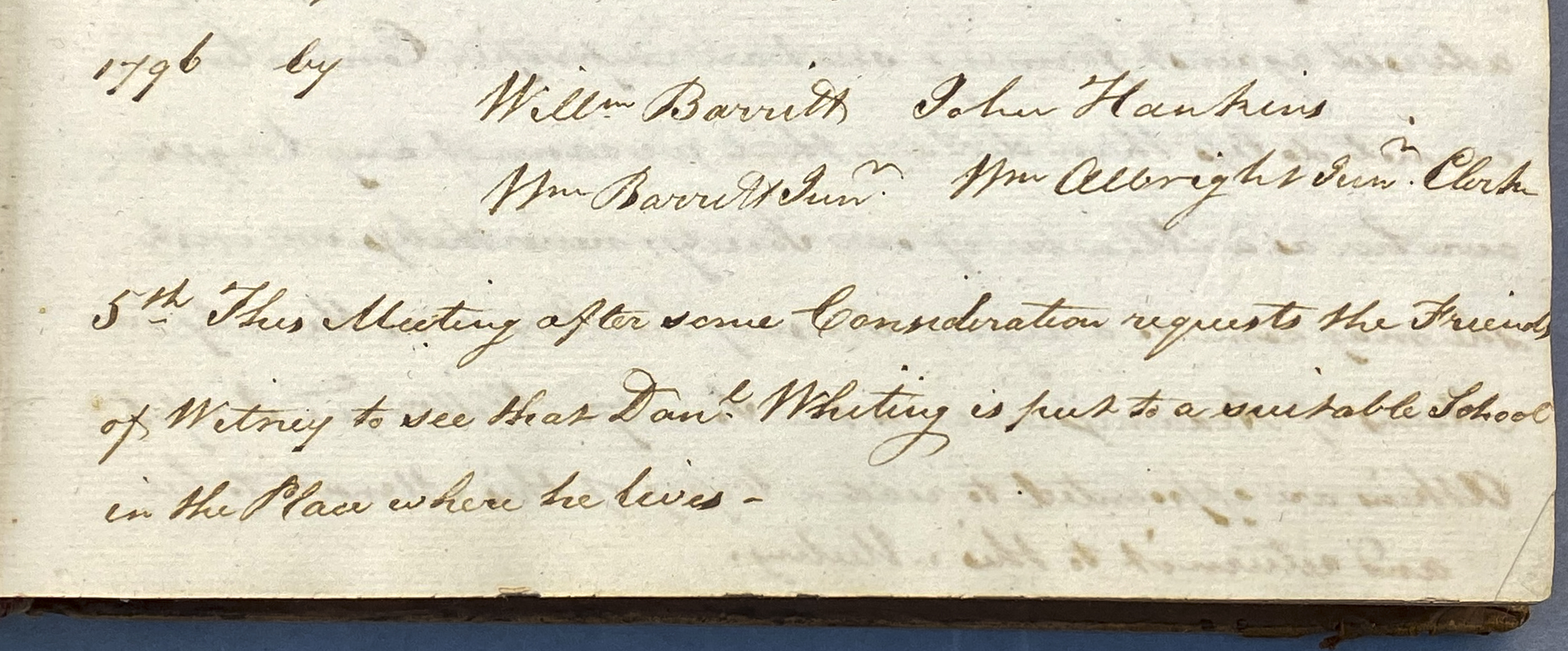
Reference: NQ3/1/A1/8
Another son Richard moved to London and the Minute Book has an entry in October 1787 requesting a removal certificate for Richard Whiting to Gracechurch Street. In it the meeting refers to him being a sober young man and free from marriage engagements.

Reference: NQ3/1/A1/7
Esther, one of William’s daughters, seems to have been much travelled because there are several entries relating to her movements including one in March 1787 when she also removed to Gracechurch Street. The removal certificate refers to Esther’s youth – ‘respecting Esther Whiting that they do not find but that she was of an orderly life, her youth exempting her from marriage’.

Reference: NQ3/1/A1/7
In September 1790 she returned from London. Amongst the Gracechurch Street signatories on the certificate is that of her older sister Mary Whiting.
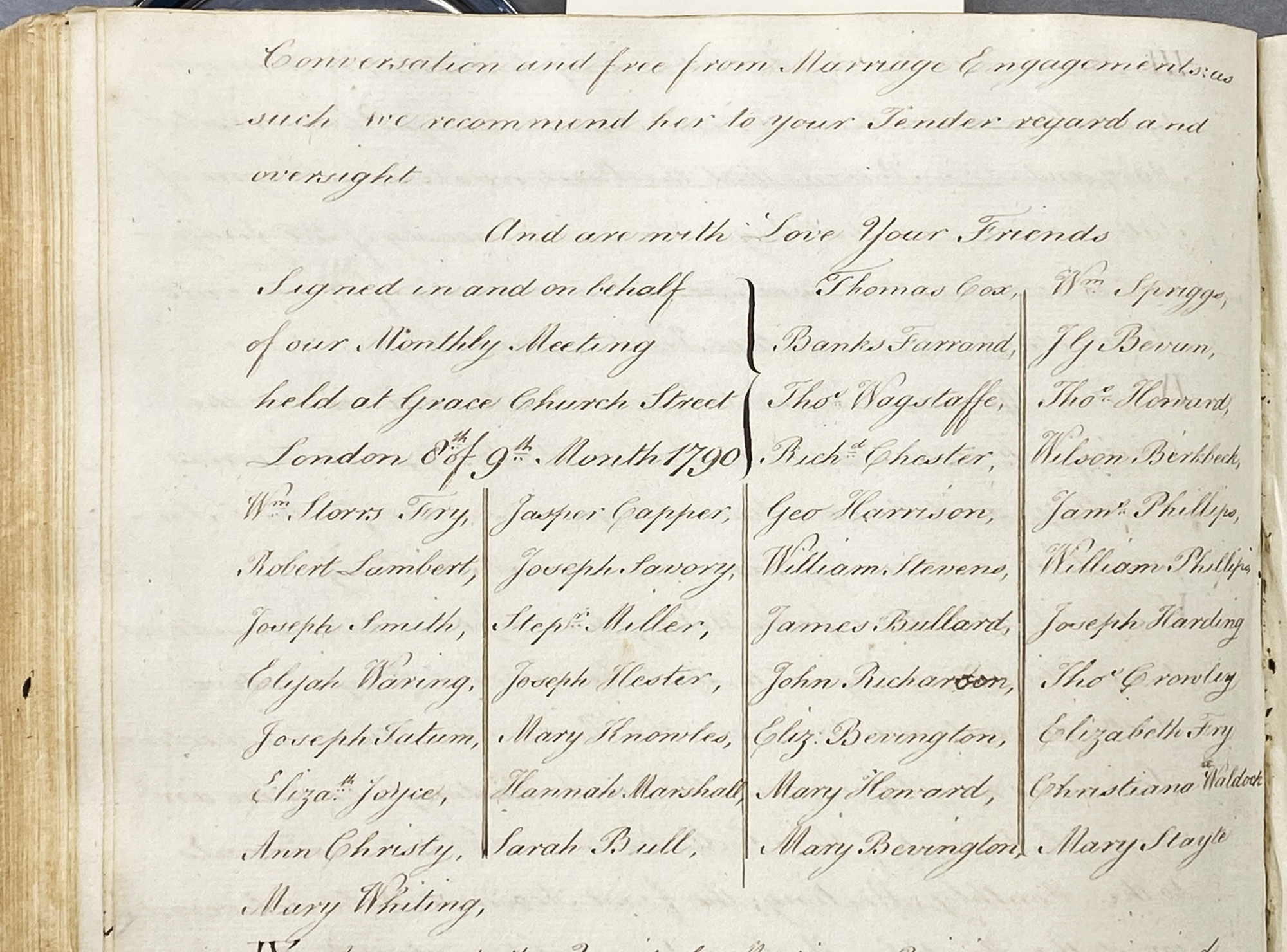
Reference: NQ3/1/A1/7
In conclusion it is thanks to the extent of the various Friends’ records and the detail within them that so much information on the Whitings’ lives and circumstances has been found, which, as we’ve seen, led to other avenues of research that otherwise might have remained hidden. This just shows that discovering Quaker ancestors can be a real blessing.
Posted by: Simon Burbidge, Oxfordshire History Centre volunteer