
Fig. 1 Henry Taunt’s shop at 9 and 10 Broad Street in the 1870s. Taunt was a keen cyclist, and at this time he was also selling and repairing bicycles at another shop in New Inn Hall Street.
Reference: POX0105366
18 November 2022
Henry Taunt, the famous Oxford photographer, died one hundred years ago this month, on 4 November 1922. The centenary is a perfect opportunity to revisit his astounding legacy and to re-consider what we know about him. The passage of time has meant that for many years it has been impossible to interview anyone who knew Taunt, but digitised local newspapers and later censuses have provided new insights into his life.
Taunt was in business as a photographer from 1868 until his death in 1922 at the age of 80. Starting out with a small shop in George Street, he soon moved to Cornmarket Street and then in 1874 to larger and more prominent premises at 9 and 10 Broad Street. (Fig. 1) Soon outgrowing the Broad Street shop, he leased Canterbury House in Cowley Road as his photographic works in 1889, and some 60,000 photographs, all glass plate negatives, taken by Taunt and his assistants were ultimately stored in sheds built behind the house. Around a third of these photographs were taken for sale as prints or postcards, or for reproduction in one of Taunt’s many publications. The rest were the result of commissions by individuals, businesses, colleges, schools and other bodies. (Fig. 2)
Fig. 1 Henry Taunt’s shop at 9 and 10 Broad Street in the 1870s. Taunt was a keen cyclist, and at this time he was also selling and repairing bicycles at another shop in New Inn Hall Street.
Reference: POX0105366

Fig. 2 Young woman winding bobbins in the loom shop at Early’s Witney blanket factory, 1898. Taunt’s photograph was one of a series commissioned by Charles Early & Co., to illustrate the blanket making process.
Reference: POX0117027
Victorian Oxford was something of a mecca for the commercial photographer, with well-to-do undergraduates wanting pictures of themselves and souvenirs of their time at the university. Colleges became regular clients, requiring photographs of their students and sporting groups. Growing numbers of tourists provided another valuable market over and above the purely local demand that would have existed in any contemporary county town.
Henry Taunt was just one of many photographers operating in late 19th and early 20th century Oxford, but it is his contribution that stands out today. One reason for that, sadly, is that the work of most of his rivals has not survived, but Taunt’s photographic output was remarkable not only in quantity but also in its quality, topographical range and variety. Contemporaries were quick to comment on the technical excellence of Taunt’s images, and, transporting all his equipment by boat, bicycle or train, he swiftly extended his coverage beyond Oxford and Oxfordshire to include the river Thames from source to sea as well as neighbouring counties. (Fig. 3) His historical interests also led him to copy old maps, prints and drawings which he could then compare with his own photographs in books and lectures.
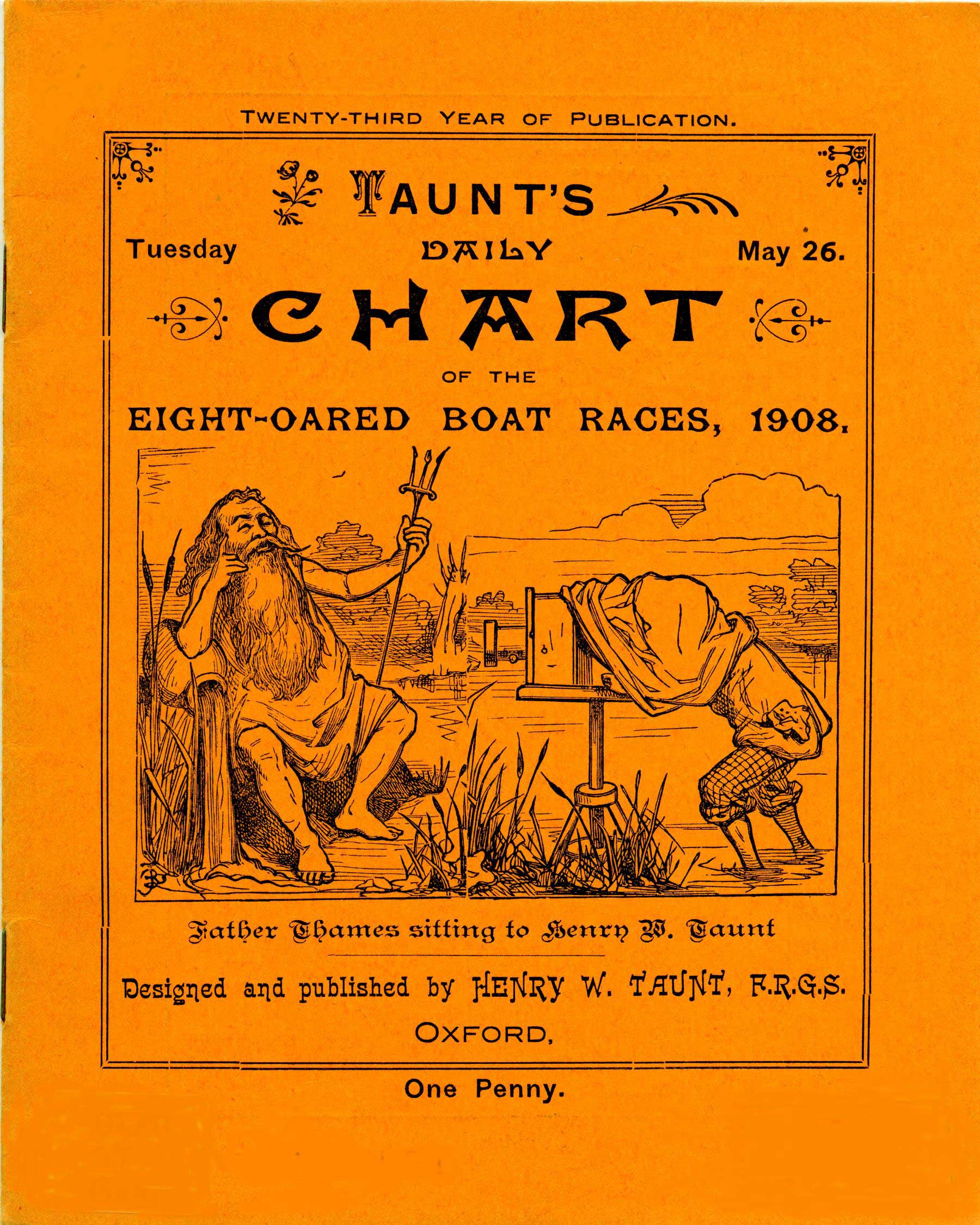
Fig. 3 Drawing showing Father Thames posing for his photograph taken by Taunt. Taunt’s views of the Thames soon made his name and, through his photographs, books and lectures, he did much to promote leisure use of the river.
Reference: POX0250281
Whereas Taunt’s rival photographers might modestly advertise their services in local newspapers and directories, he had a relentless drive for self-publicity. He summarised this philosophy in verse in 1914:
He who has a thing to sell
And goes and whispers down a well,
Is not so apt to cop the dollars
As he who climbs a tree and hollers.
Taunt took lantern slides of photographs from his New Map of the River Thames first published in 1871 to towns and villages along the river and further afield. He entertained audiences with his experiences of camping out by the river and amazed them by using an oxy-hydrogen lantern and limelight to cast images up to twelve feet long on to the walls. (Fig. 4)
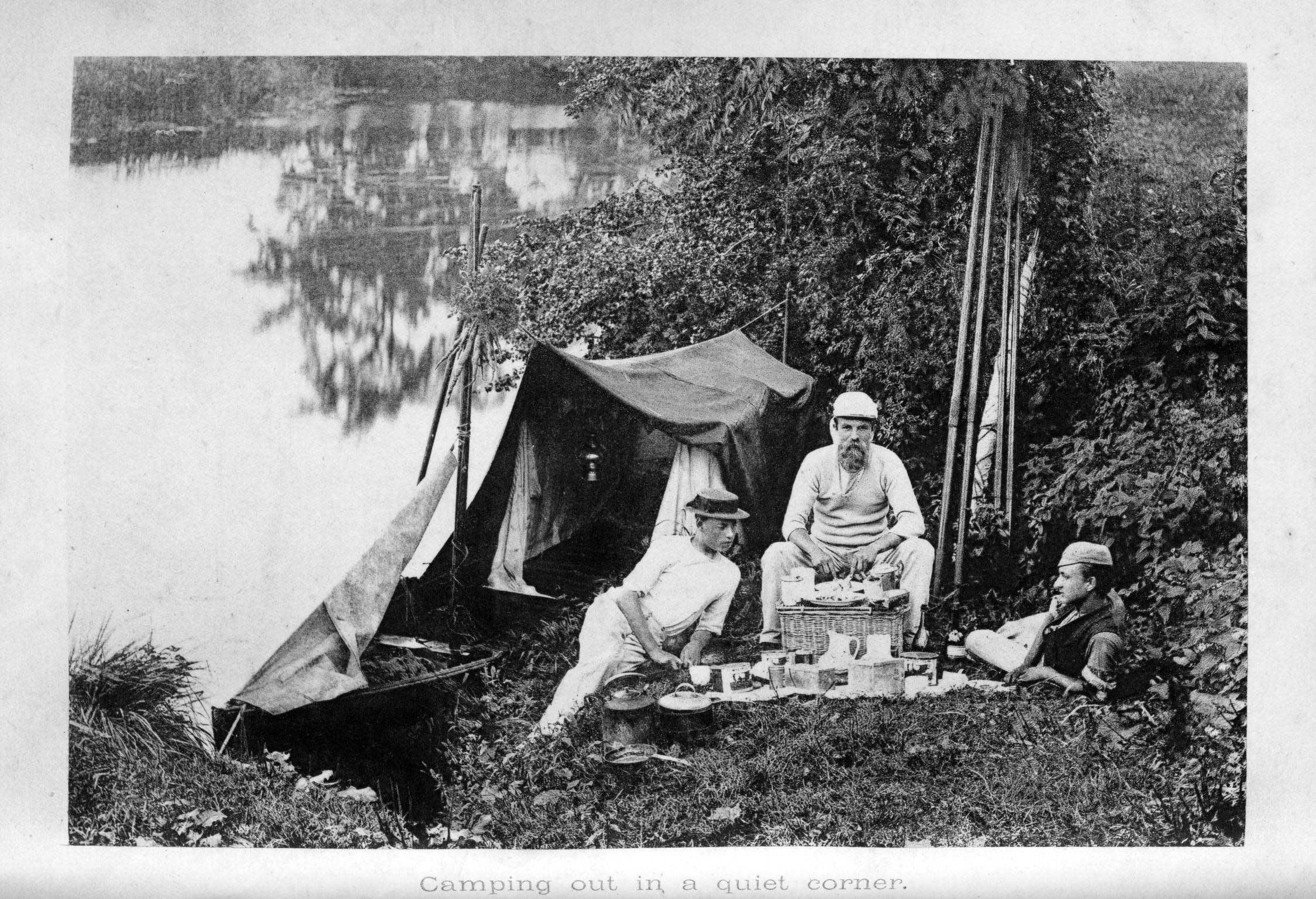
Fig. 4 Taunt and his assistants camping out beside the river, perhaps at Stratford on Avon in 1874. The camping skiff was Taunt’s usual means of river transport in his early years, carrying all his photographic equipment and providing very basic sleeping accommodation.
Reference: POX0250277
Taunt’s books always featured copious advertisements for his other products, and he published an occasional newsletter, Notes and News from Oxford’s Famous City between 1908 and 1914, which promoted his many commercial activities. In 1891, when he had the opportunity to fill in his return for the national census, he listed his occupations as ‘artist in water colours, photographer, author, designer, lecturer, lantern slide painter, picture frame maker, gold blocker and printer, publisher, mount cutter, ornamental card maker, entertainer, gilder.’ (Fig. 5) By 1921, he had added picture postcard manufacturer to the list.

Fig. 5 Advertisement for Henry Taunt’s many entertainments and lectures in the 1900s. The advert illustrates the type of oxy-hydrogen lantern that he used, and displays examples of the remarkable collection of types which Taunt assembled for his printing work.
Reference: TAUNT 41 Newspaper cuttings book, 1873-1908
Taunt’s career demonstrates that he was a colourful character and, thanks to his personal archive and local newspapers, we can certainly get a good idea of what he was like. Physically, he was a tall, well-built man who, as a regular river user, often dressed in a kind of nautical uniform complete with cap. (Fig. 6) Brought up in St Ebbe’s, the son of Henry Taunt, a plumber and Martha, a dressmaker, he left school at the age of ten, but his upbringing clearly inspired him with a love of learning. He was a Conservative in national politics but firmly independent locally, campaigning vigorously on environmental issues and against what he took to be wasteful local government expenditure. He used photography in some of his campaigns, photographing the mussels and shrimps that emerged from his tap during his battle for pure, filtered drinking water in 1881. (Fig. 7) He opposed the introduction of electric trams in Oxford in the 1900s, firstly on economic grounds but later because he feared posts and wires along the High Street. (Fig. 8)

Fig .6 Henry Taunt at the gate leading to St Lawrence’s Church, North Hinksey, c. 1900. The photograph was probably taken by Taunt’s assistant, Randolph Adams, during research for his book The Oxford Poems of Matthew Arnold.
Reference: POX0088785

Fig. 7 Poster issued by Taunt during his campaign for clean City water in 1881, promising an ‘inquest’ at the Royal Blenheim in St Ebbe’s Street. His photographs of the creatures found in his tap water have not survived.
Reference: TAUNT 41 Newspaper cuttings book, 1873-1908

Fig. 8 A typically combative Taunt poster in 1911 expressing horror at the prospect of electric tramway posts and wires in Oxford’s High Street and suggesting a cover-up by city councillors.
Reference: TAUNT 41 Newspaper cuttings book, 1873-1908
Henry Taunt’s entertainments and his jingles, or light verse, prove that he had a sense of humour, and he clearly valued hard-working employees. Randolph Adams joined Taunt’s staff as a boy in 1885, and went on to become the photographer’s valued personal assistant, ‘the handiest I ever met with’, who took many of Taunt’s later photographs. On the other hand, occasional court appearances and surviving correspondence reveal a man who did not suffer fools gladly! In 1878, he was fined for assaulting an apprentice, James Best, who had damaged some of his precious plates; the newspaper report of the struggle between the two men reads like something out of an early slapstick comedy film. The Great Western Railway regularly annoyed Taunt by over-charging (as he saw it), damaging his photographs and delaying deliveries. When a railway official, Mr Gamble, tried to defend the company in 1922, Taunt told him not to ‘write childish twaddle but do your own business properly if you can, and wait until I ask you before you attempt to teach me how to manage mine.’
Henry Taunt married Miriam Jeffrey, an Oxford dressmaker, in 1863, and she assisted him in his various enterprises. She was working with him as photographic finisher in 1871, she spoke up for him in the James Best case and she supplied costumes for his children’s entertainment Dame Wiggins of Lee in 1888. (Fig.9) The marriage was childless, but there is no evidence of any disharmony between the couple. Another woman, Frances or Fanny Miles came into Taunt’s life in 1873 when she became the manager of his branch in High Wycombe. She was probably the lady photographed with Henry Taunt on the houseboat cum camera platform which he used in later years for more comfortable trips down the Thames. (Fig. 10)

Fig. 9 Programme for Taunt’s musical entertainment Dame Wiggins of Lee, performed in December 1888. His wife Miriam helped with the costumes for the production.
Reference: TAUNT 136 Dame Wiggins of Lee, 1888

Fig .10 Henry Taunt and a lady, thought to be Fanny Miles, on the houseboat used in his later years for photographic expeditions down the river Thames.
Reference: POX0110830
When Henry Taunt acquired Canterbury House in Cowley Road in 1889, he installed Fanny Miles there as his tenant, but he and his wife continued to live above the Broad Street shop. Taunt renamed Canterbury House Rivera after his beloved River Thames - woe betide anyone who pronounced it ‘Riveera’! – and Fanny Miles lived there until his death. It appears that she provided moral and probably financial support when Taunt, facing bad debts and problems over the renewal of his Broad Street lease, was declared bankrupt in 1895. Until at least 1911, she officially controlled the business of Taunt & Co., employing Taunt as her manager but, in the 1921 census, they are described as partners with Fanny Miles working as photographic finisher.
Forced to relocate his central Oxford shop from Broad Street to 41, then 34 High Street, after his bankruptcy, Taunt and his wife were living near Rivera at 7 Marsh Cottages, Cowley Road by 1901. In 1911, Fanny Miles as head of household and Taunt were resident at Rivera while Miriam Taunt occupied 434 Cowley Road with Fanny’s niece, Mary. By 1921, all four were living at Rivera, and visitors got the impression that Miriam lived upstairs and out of sight. Henry Taunt wrote a heartfelt poem stressing his debt to Fanny Miles and describing her as ‘my Little Lady’, but we can’t really be sure about their relationship or how it was viewed by Taunt’s wife. Ethel Pocock, evidently a long-term friend of Henry and Miriam Taunt, accepted the arrangements at Rivera with complete equanimity, noting in a poem written in 1918:
Miss Miles and you, since first we met
Both kindness great have shown,
And, thanks to you, in many ways
We pleasant times have known.
Taunt clearly saw himself as a model of propriety when he wrote to the Mayor in 1897, complaining about improper goings-on by youths and girls on the stile leading into the recreation ground opposite his house; in typically robust fashion, he threatened to go and saw the stile down himself if nothing was done! (Fig. 11) There were skeletons in his cupboard, however, for he had received a court order in 1883 to support the illegitimate child of Louisa Bricknell. In 1891 another woman, Emily Bowell, brought a similar charge against him only to withdraw it at the last minute. Other liaisons were rumoured, and Phyllis Musto, reminiscing about her East Oxford childhood, said that her mother had warned her to stay away from Taunt. This may well have been due to his reputation for irascibility since, as William Adams recalled, ‘he could be a real dear old chap and he could play merry blazes.’ Taunt seems in fact to have been genuinely fond of children, and he presented popular magic lantern entertainments every Christmas in the Town Hall between 1873 and 1893. Local children, safely out of range perhaps, called him ‘Old Skelly Taunt’, and he photographed some of them at the sheep-washing place in Barracks Lane. (Fig. 12)
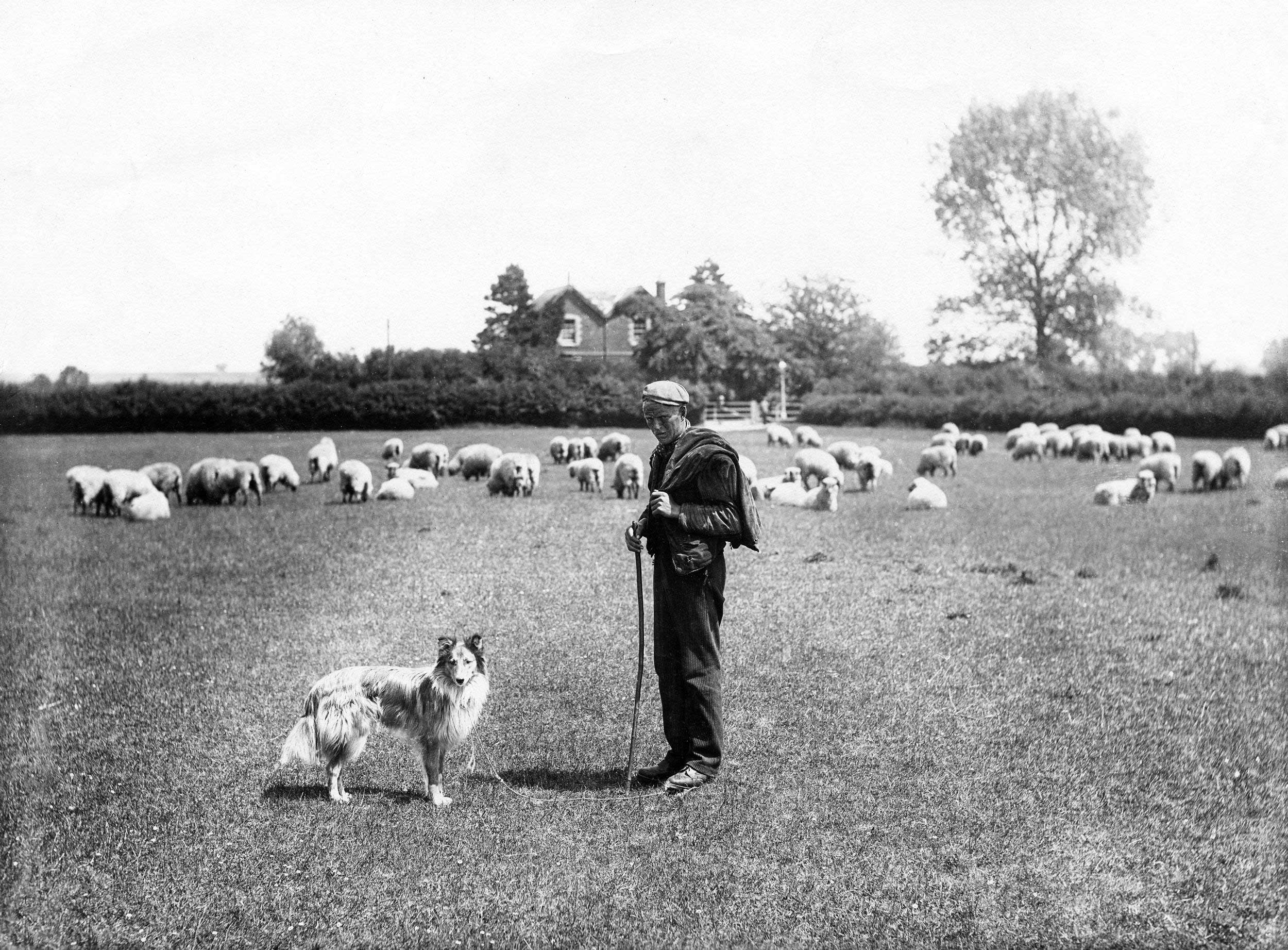
Fig. 11 A shepherd and his sheep on the Cowley Road recreation ground, 1901. Taunt’s house Rivera can be seen in the background with the offending stile beside the lamp-post.
Reference: POX0111340
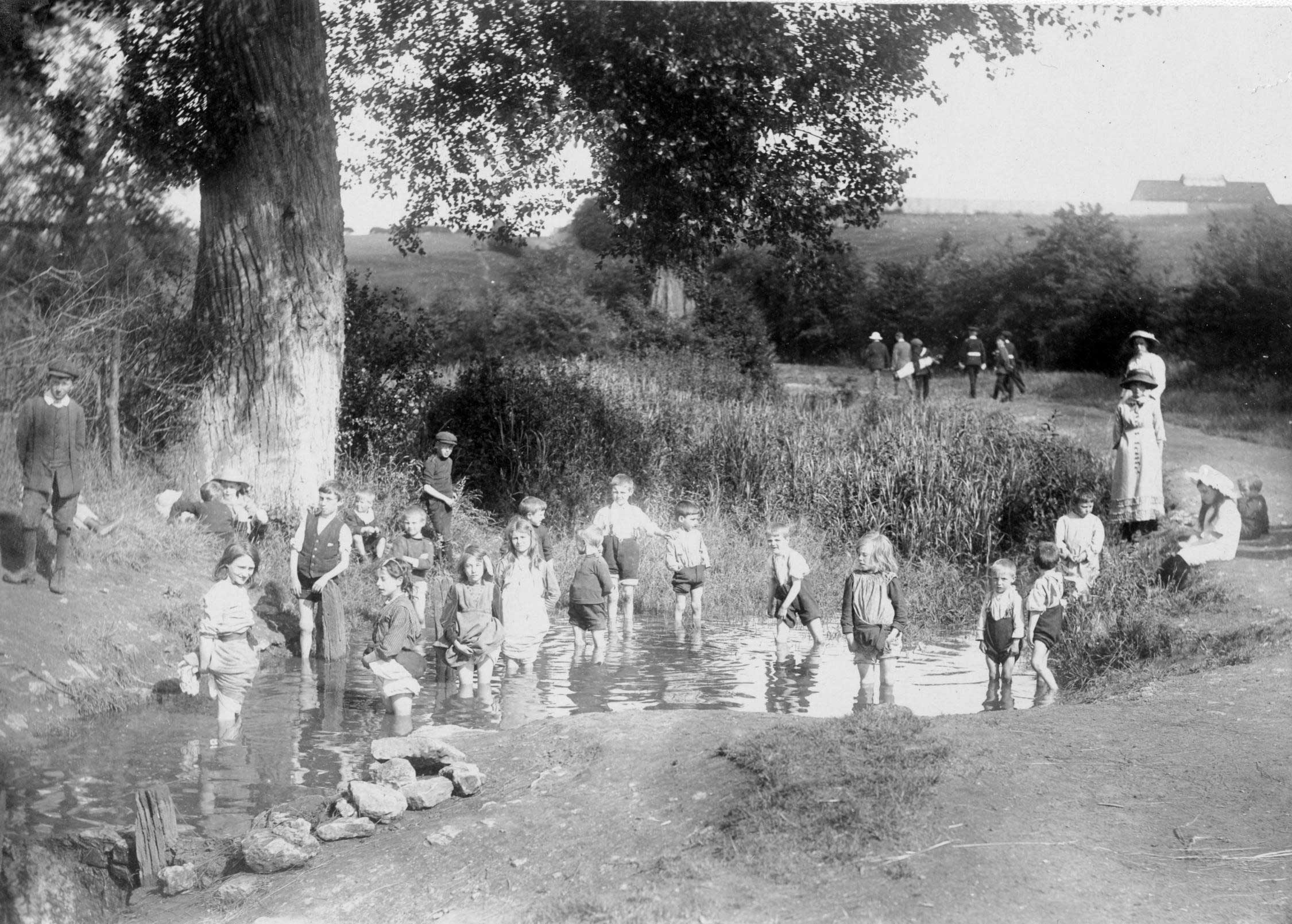
Fig. 12 Children playing in the sheep-washing place on the Boundary Brook in Barracks Lane, 1914. This was one of a series of photographs by Taunt recording the area around his house in Cowley Road.
Reference: POX0111160
Henry Taunt died at Rivera without leaving a will so it was perhaps due to financial uncertainty that he was buried in an unmarked grave in Rose Hill Cemetery on 8 November 1922. (Fig. 13) Randolph Adams kept Taunt’s picture postcard business going for a few years at his home, but other aspects of the business ceased immediately. The land behind Rivera had become a valuable building site, and it was soon acquired by Frank Organ, a local builder. The sheds and outbuildings containing vast quantities of equipment, glass plate negatives, lantern slides, printing types, books, cuttings and manuscripts had to be emptied and removed. Fortunately, the historical importance of Taunt’s photographs had long been appreciated, and the Oxford Chronicle reported in December 1922 that Ernest Skuce, the Oxford City Librarian, had examined the material at Rivera and was preparing a report for the Library Committee. Some clearance work probably took place during 1923, but, between 1924 and 1925, the City Council purchased a substantial part of Taunt’s collection, including negatives, prints, books and papers, for £98 10s 0d.
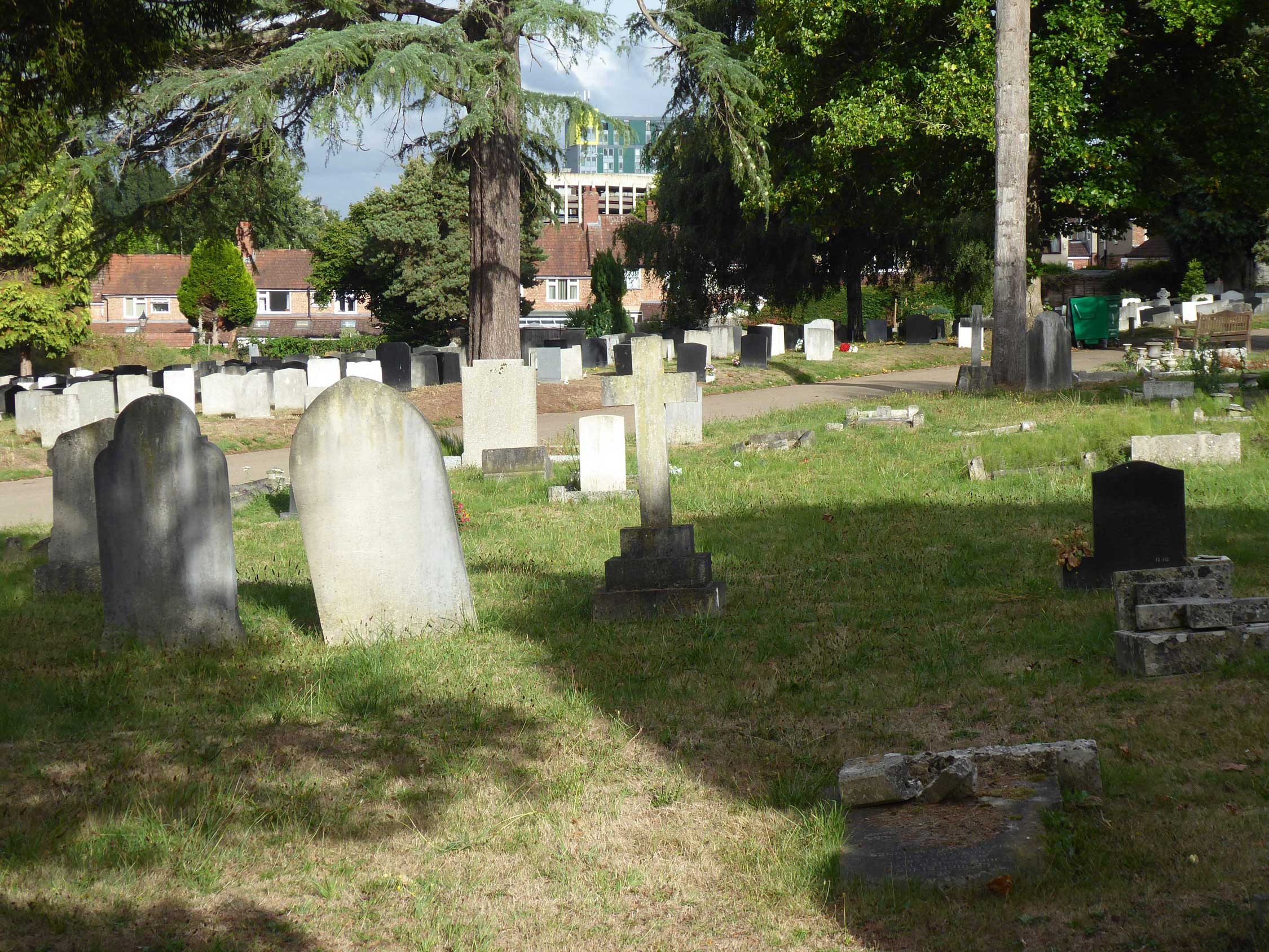
Fig. 13 Rose Hill Cemetery in 2022 looking towards Cowley Centre. Henry Taunt and, in 1929, his wife Miriam were buried in an unmarked plot in this area near the cemetery chapel.
Reference: MG P1020968
This was a remarkably far-sighted decision, but the purchase was to provide many long-term challenges. The City Library building had been condemned as inadequate in 1911, and there was insufficient space to adequately house a collection which included thousands of large and fragile glass plate negatives; the library service was also generally regarded as under-funded and under-staffed. The Library Committee authorised the disposal of some negatives and lantern slides in 1929, and supplied negatives for use as greenhouse glass in 1935. Many of Taunt’s commissioned photographs of people, groups and businesses were perhaps destroyed at this time, although it is not certain that they had ever been selected for preservation. (Fig. 14) The library subsequently passed non-Oxfordshire negatives to appropriate county societies and, in 1949, transferred the remaining negatives to the National Buildings Record (NBR), today’s Historic England.
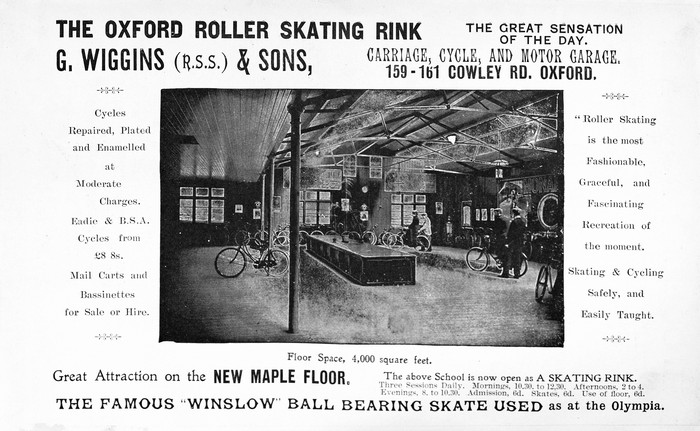
Fig. 14 Advertisement for Wiggins’ cycle shop In Cowley Road incorporating a Taunt photograph of the firm’s cycle training and roller-skating rink, c. 1910. Like most of his commissioned images, the original negative of this photograph was not preserved.
Reference: TAUNT 41 Newspaper cuttings book, 1873-1908
Oxford City Library retained thousands of Taunt’s photographic prints, many bearing only his negative numbers. During the 1960s, staff and knowledgeable volunteers valiantly tried to identify these images, and it was only discovered much later that the library had passed Taunt’s original negative registers to the NBR! By the 1980s, 60 years after Taunt’s death, all his surviving photographs were publicly available, but only to people in the know and, unhelpfully, in two different archives, one in London (later Swindon) and one in Oxford. The development of digitisation made virtually reuniting these collections technically possible, the National Lottery provided the necessary project funding in 2001-03, and you can now explore over 14,000 Taunt images on Oxfordshire County Council’s Picture Oxon website and Historic England’s website. Taunt’s many publications, unpublished works and other manuscripts are catalogued on Heritage Search, and you can see them at Oxfordshire History Centre.
Henry Taunt’s house lay in a rural setting on the Cowley Road between the growing East Oxford suburb and Cowley village when he acquired it. By his death, a ‘White City’ of council houses had been built almost opposite, and the recreation ground which had caused him some annoyance soon gave way to housing. The land behind and beside Rivera became the site of Cowley Road bus garage in 1924, but Taunt’s house, now prosaically numbered 393 Cowley Road, was adapted as offices. Oxford Civic Society crucially marked its connection with Henry Taunt by placing a blue plaque on the property in 2008, and Rivera, now once again called Canterbury House, was retained during the redevelopment of the bus garage site in 2016. (Fig. 15)
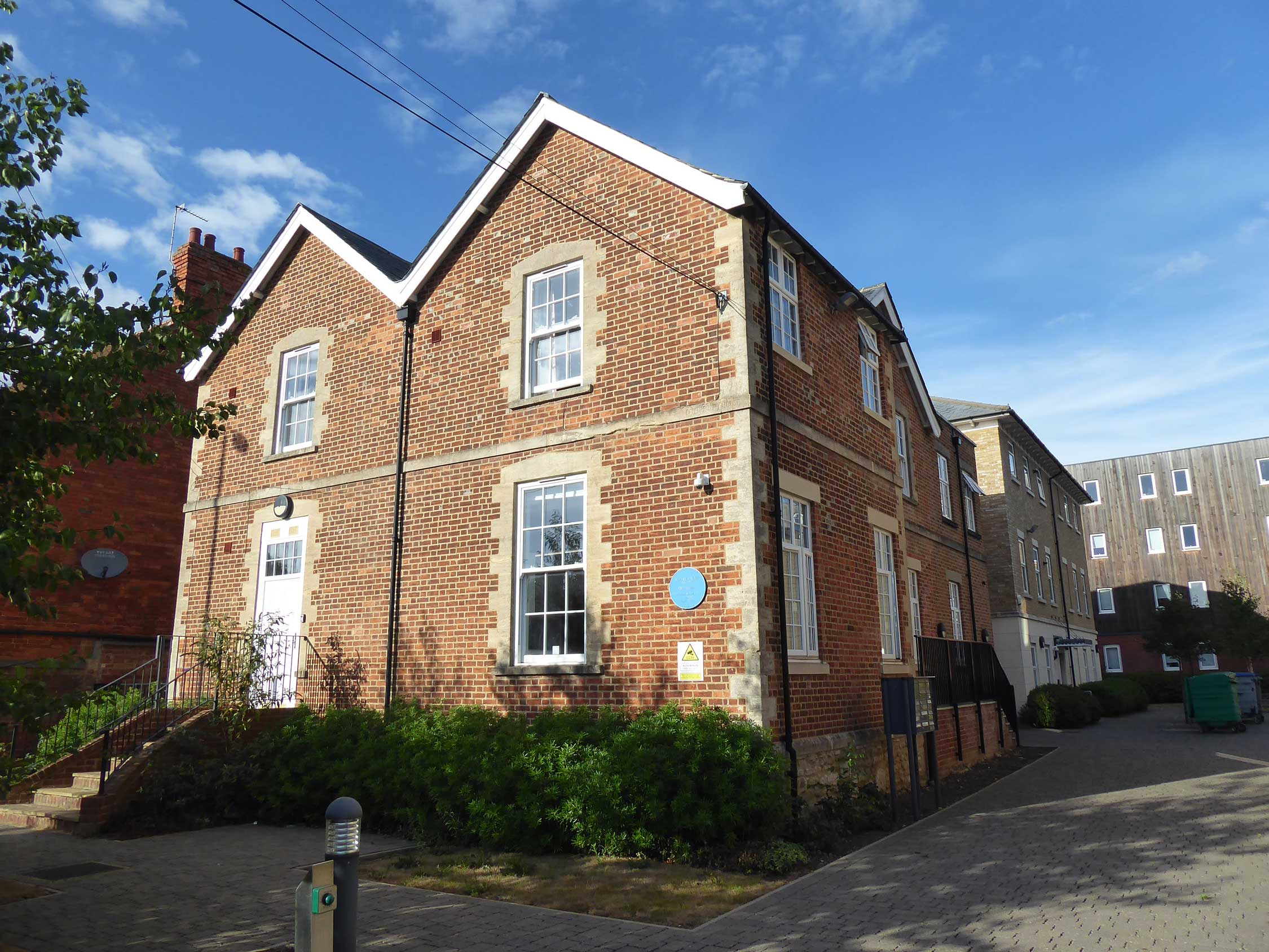
Fig. 15 Henry Taunt’s house in Cowley Road in 2022 with a blue plaque recording his time there. He renamed it Rivera after the river Thames, but the property is now known by its original name, Canterbury House.
Reference: MG P1020971
Posted by: Malcolm Graham, Oxfordshire History Centre volunteer