
Harold Herring's box of photographic glass negatives, with each one enveloped and carefully labelled
22 October 2021
Recently, Oxfordshire History Centre was privileged to receive a donation of glass photographic negatives, taken in c. 1910 by Harold Herring, and other photographs, giving a glimpse into the Herring family and their life in the north Oxfordshire village of Blackthorn about a century ago.
Harold Herring's box of photographic glass negatives, with each one enveloped and carefully labelled
The images contained on the glass negatives, and related photographic prints, are available to view on Picture Oxon.
Some of the glass negatives sustained water damage during their long life, as a result of one of the Blackthorn floods. Where possible this has been cropped from the scanned image without appreciable loss to the image itself.

Floods at Blackthorn: John Herring's Fir Tree Farm is on the left, and a meal / bread delivery cart looks ready to navigate the waters.
(reference: POX0626297)
Accompanying the photographs were some fascinating typescript reminiscences: A rural childhood, 1948–1968 (by Philip Anthony Herring), and Blackthorn remembered and I remember Blackthorn (by Rowland Herring). With grateful acknowledgement, much of what follows is a précis of those accounts.
The Herring family itself can be traced back to the seventeenth century from Ickford in Buckinghamshire ref 1, where they were yeomen farmers. Perhaps the first connection between the Herring family and Blackthorn happened on 2nd March 1829 when John Herring from Marsh Gibbon married Mary Anne Ayres from Blackthorn. A more permanent relationship came about in c. 1847 when Rowland Herring, also from Marsh Gibbon, bought a limestone house, dated 1789, two cottages and a wheelwright’s shop off Weir Lane. The latter two were converted into a bakehouse and storerooms, and would become Blackthorn Bakery. On the 19th November 1843, Rowland Herring, a baker, the son of Rowland, also a baker, married Mary Ann Scott from Bicester, both parties being described as being ‘full age’.

Possible portrait of Rowland (or Richard) Herring in c. 1840, who bought the bakery buildings in 1847.
(reference: POX0626303)
In 1847 Rowland Herring acquired ‘Blackthorne Manor’ for £400. The 1851 Census shows Rowland employing Harvey Herring (relationship unclear) and George Bartlett to assist him in the bakery. By this time, they have three children: Mary Ann, Ellen and Rowland. Three more would follow in the ensuing decade: John, Albert and Amelia; and they are able to employ two servants. Rowland died in the spring of 1870, aged 59, the funeral taking place on the 29th April. In the 1871 Census it is Mary Ann who is recorded as the head of the family, and as a baker, along with the younger Rowland and John. The youngest of the children is Thomas, who would go on to start the successful grocery business in Bicester. It was probably the older Rowland Herring’s son, the older John, who added the brick and slate extension to the rear, giving the building its L-shape.
John took over the bakery business – he married Esther Ann, the daughter of James Jones of New House Farm and would keep it in his care until his death aged 77 in 1930, the funeral taking place on the 10th December.
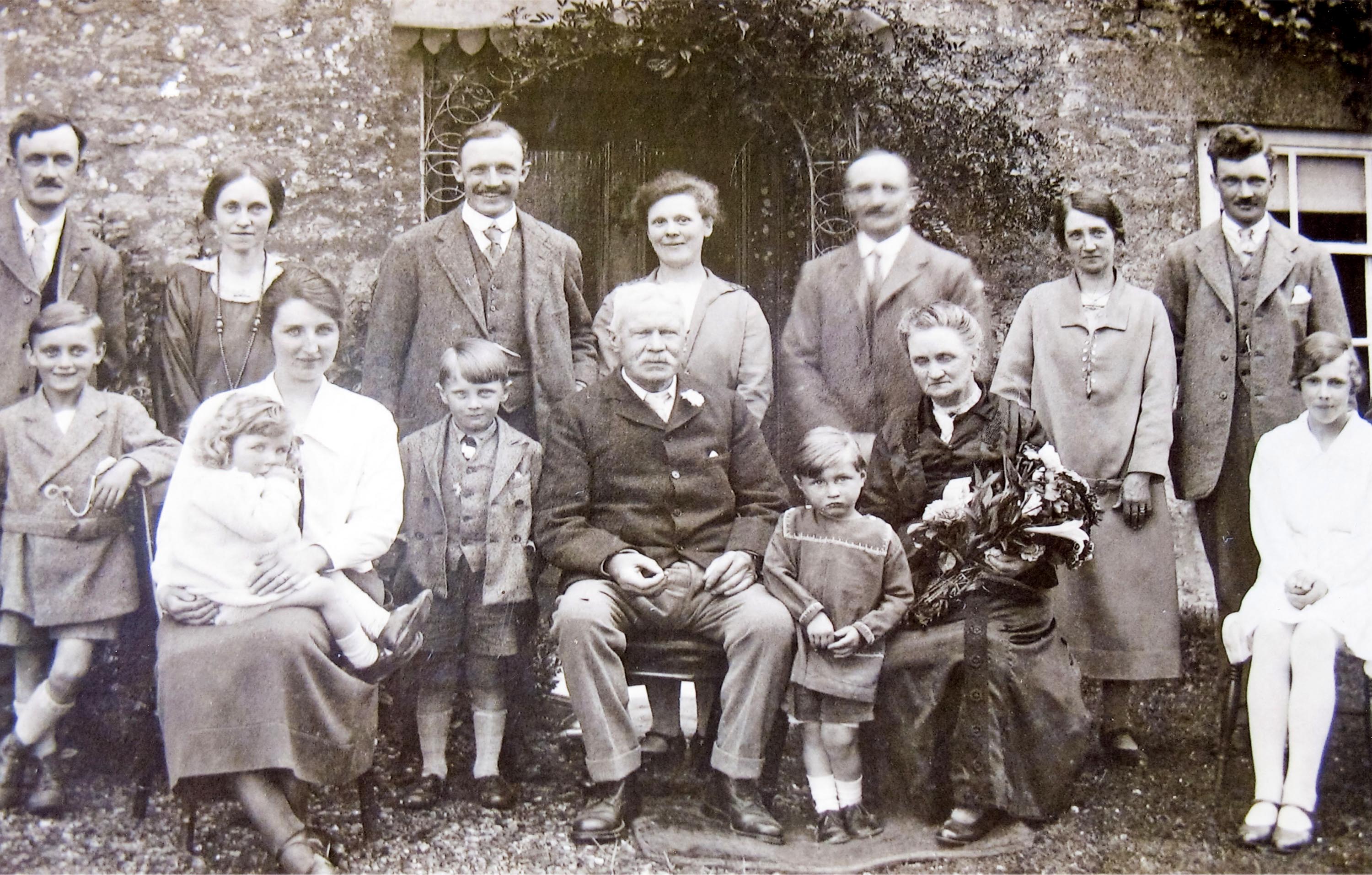
Family group at the celebration of the golden wedding anniversary of John Herring and Esther Jones, in front of The Bakery, Blackthorn.
(reference: POX0626289)
In I remember Blackthorn, Rowland Herring gives the following description of the bakehouse and the daily routine; “In the bakehouse there were two wide and deep ovens and six dough-troughs or ‘kivvers’ [dialect term for a shallow wooden vessel or tub] between them. There was a wooden ladder up to the loft where the sacks of flour were kept. Above the ovens was a thick layer of organic insulation.
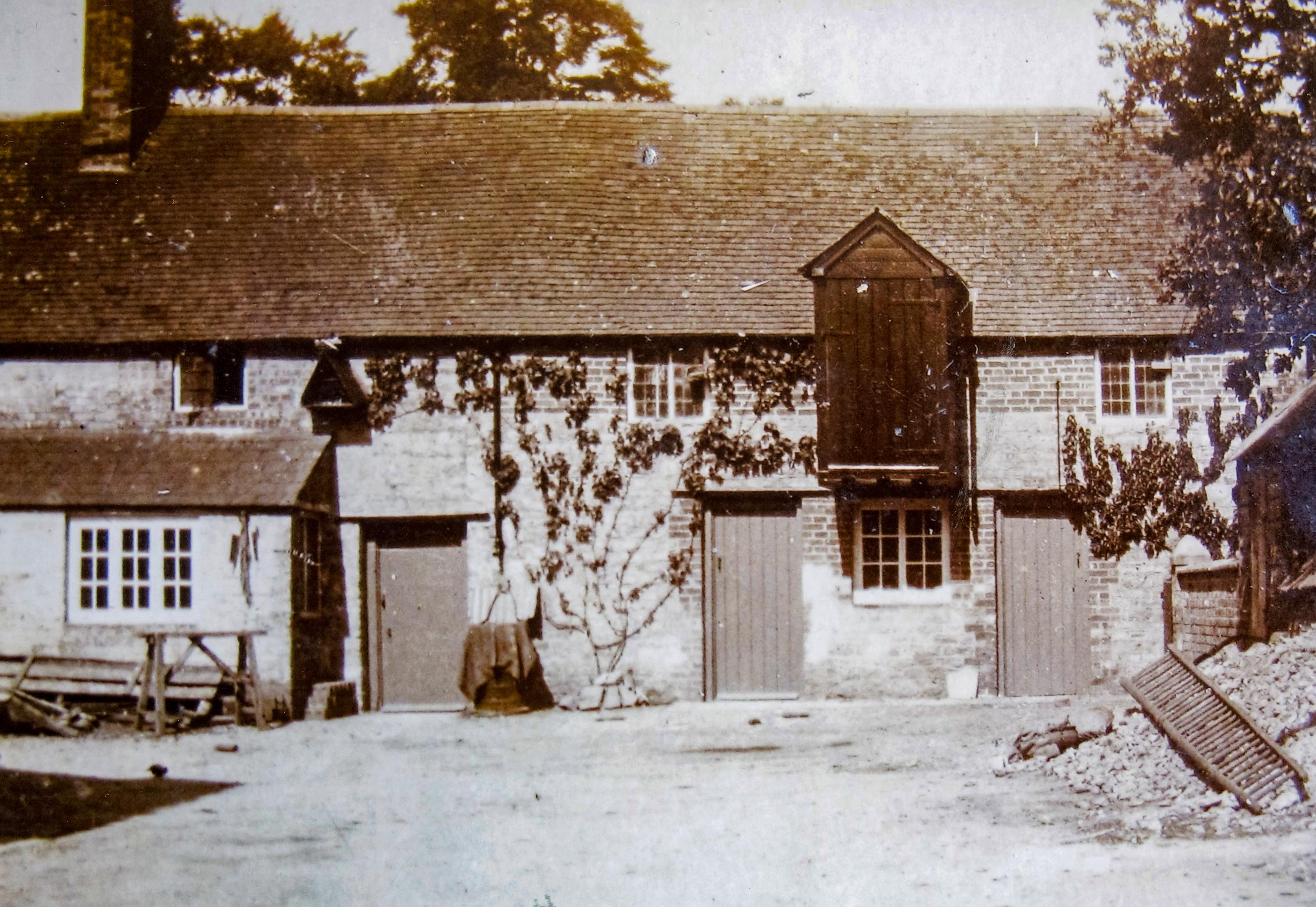
The bakehouse yard at Blackthorn - the ovens were through the left-hand door.
(reference: POX0626293)
The head baker was Tom Kitely who cycled the five miles in from Grendon Underwood on his trusty old bicycle, lighting up the ovens around 6.00 a.m. He and Harold lifted the dough, which had been ‘proving’ all night, from the triangular shaped kivvers, using the lid as a work-surface to mould it into five different types of loaf. A ‘peel’, rather like a long paddle, was used to slide the bread-making tins into the ovens. Then Harold would start on the dough-cakes and John would go delivering animal foodstuffs to farmers, which was as profitable as baking.

Harold Scott Herring in the centre, with two bakers employed by John Herring senior, and a delivery from Enslow Mills.
(reference: POX0626302)
In the afternoon Tom would take bread out to Marsh Gibbon, Charndon and Twyford while John covered Piddington, Ludgershall and Blackthorn itself. Harold stayed to deal with customers, fetch coal and water for the next day, clean the stable and put out hay for the horses’ return. When Tom came back he would prepare the dough or ‘sponge’ in the kivvers for proving over-night.” ref 2 The heat of the oven was not wasted. Very often, particularly at weekends, some of the village people would bring their own joints of meat, or pies and cakes to be cooked, in exchange for a few coppers. ref 3
The Bakery thus became one of the hubs of village social life. Little was wasted. Any unsold bread - the price in those days was 4¼ d for a large loaf and 2¼ d for a small loaf - would be stacked in the bread-house, covered with sacks, and sold at a cheaper rate the following day. Stale bread could be used to make various puddings, or to toast. ref 4
In addition to the long hours (what time did Tom Kitely have to get up in the morning to be in Blackthorn to light up the ovens at 6.00 a.m. or even earlier?), before mechanisation removed much of the manual labour involved, baking could be a dangerous occupation. In addition to the heavy labour involved in moving the sacks of flour and the risk of repetitive strain injuries caused by kneading the dough, there were the long-term dangers of lung disease caused by continual working in a dusty environment because of the flour hanging in the air, there was the continual fire hazard – flour suspended in the air can combust explosively if ignited.

Blackthorn Bakery yard with the meal lorry. Sacks were dropped from the suspended door behind into the cart below. The lorry, registration U-1191, belongs to J. S. and J. Horwood, Enslow Mills, Bletchingdon, and was made by Mann's Patent Steam Cart and Wagon Co., Leeds.
(reference: POX0626298)

The bakery yard at Blackthorn, with delivery carts possibly off on their bread delivery rounds to outlying villages.
(reference: POX0626316)
Rowland Herring’s reminiscences compliment the scenes captured on the glass plates by Harold those many years ago recalling a past age; “Then there was hay-making time, this was all done using horses and man power and the corn harvest too. It was always a relief to have the hay and sheaves of corn all gathered safely into the barns and rick-yards before the winter. Another big event was when the corn was threshed. The threshing box, engine and its attendants would move from farm to farm. The box would be set up, a gang of men assembled, each having their allotted task and soon the whine of the sheaves going through the drum would be heard. It was a lovely sight to see the golden corn coming out of the chutes, bagged and carried into the safety of the barn.” ref 5
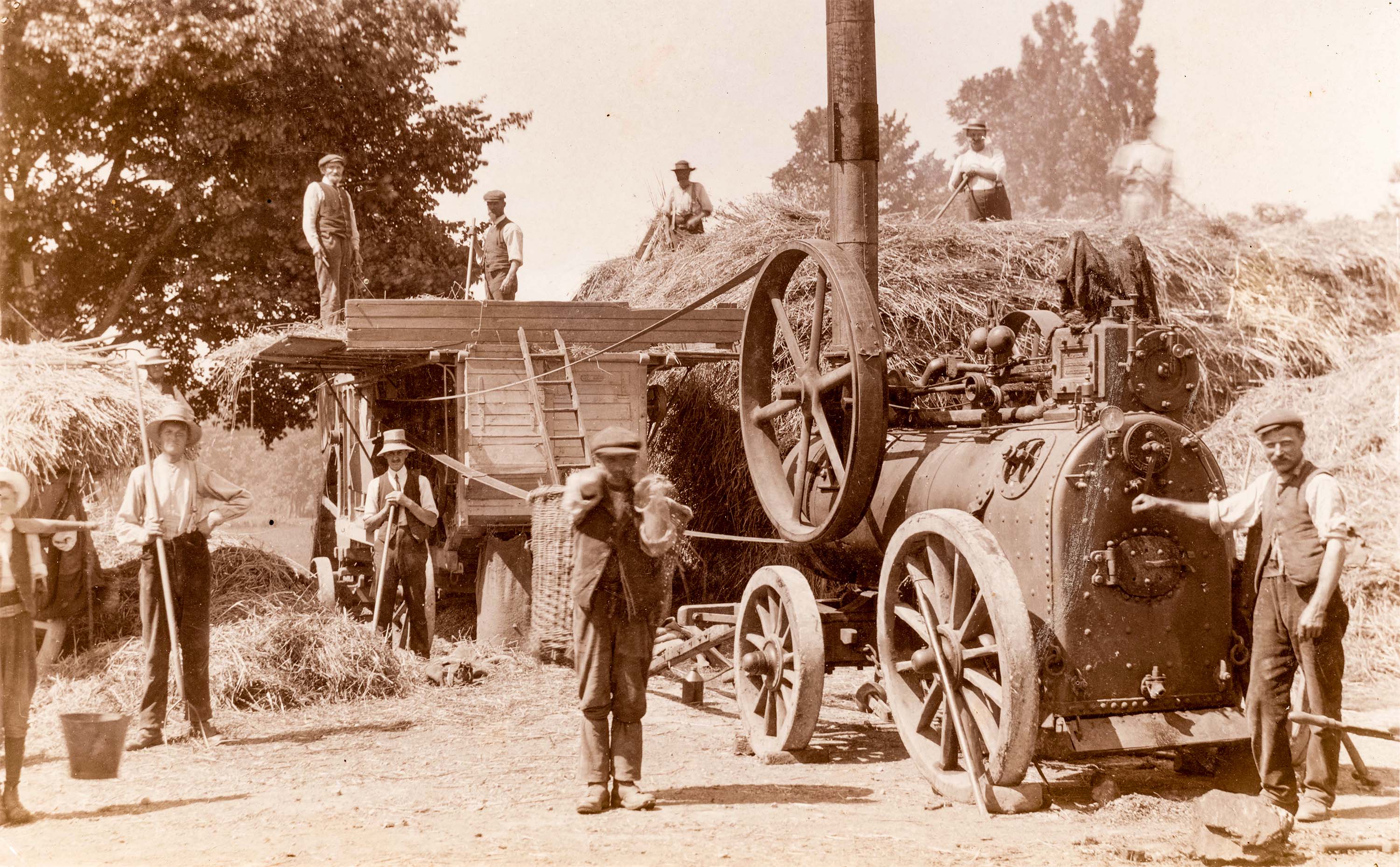
Charlie Jones, Tom Jones's dad, New House Farm, Blackthorn. Wheat threshing with a horse-drawn threshing machine, with men building a rick from the threshed stalks. On the extreme left is Blackthorn baker, John Herring.
(reference: POX0626269)
Blackthorn is eponymously named after the prolific sloe (Prunus spinosa) hedges around the village, with, as Philip Herring describes; “their vicious long black spines, the dense white blossoms of which looked like a late spring snowfall”. In 1960, Philip Herring continues; “Blackthorn was a collection of 14 large farmhouses, mostly in stone; 23 smaller stone or brick dwellings, including the two pubs and the policeman’s house on the hill; 7 white-washed and thatched cottages; 8 council houses and a pair of labourers cottages. There were 51 households in all – if one includes the two stone houses, a pair of stone cottages, and one farm (all on the hill) and Essex Cottages out in the sticks... The population was around 180 souls, with 25 children of primary school age and 10 young persons approaching adulthood.” ref 6

Aerial photograph of Blackthorn village, June 1961, by Fairey Air Surveys Ltd. The A41 trunk road from Bicester to Aylesbury runs from left to right across the top of the image (click to enlarge), while the Bicester-London railway line cuts the top right diagonally.
(reference: POX0451293)
Of the buildings in Blackthorn, about a dozen have Grade II listings according to Historic England, including Blackthorn Hill Windmill. According to the Victoria County History, the population of the 'open village' of Blackthorn rose from 305 in 1801 to 417 in 1831. ref 7 According to the 2011 Census, the population of Blackthorn was 317. ref 8 One feature of Blackthorn was the “Brook”, running a little away along the Lower Road. This could, and did, cause problems, as Rowland Herring recalls: “One of the features of the village was the floods. As it was a very low lying area, nearly every year after having rains or melting snow, the roads and some of the houses especially along the Lower Road were often flooded. I have known the cottages near our house to get flooded and the occupants having to live upstairs. Their hens had to be brought round to our buildings as there was nowhere the poor things could get out of the water to get any food. All transport had to be by horse and cart as it was often too deep to wade or cycle through.” ref 9

Man, possibly Harold Herring, rescuing a motorcycle from a flooded road in Blackthorn.
(reference: POX0626270)
Thomas Herring (1863 – 1927), mentioned above, when aged just 22, founded the successful grocery business in Bicester in 1895, which would have shops initially at 41 Market Square, and from about 1906 at 52 and 54 Sheep Street, adjacent to Bicester Post Office, now the Penny Black pub, before closing their doors for the final time in c. 1970. ref 10 The premises by the old Post Office were bought by Nash’s in 1958 and demolished in 1963 and those at 52/54 Sheep Street in 1967 to make way for Woolworth’s, and subsequently Iceland. Tom left £20,000 in his will.
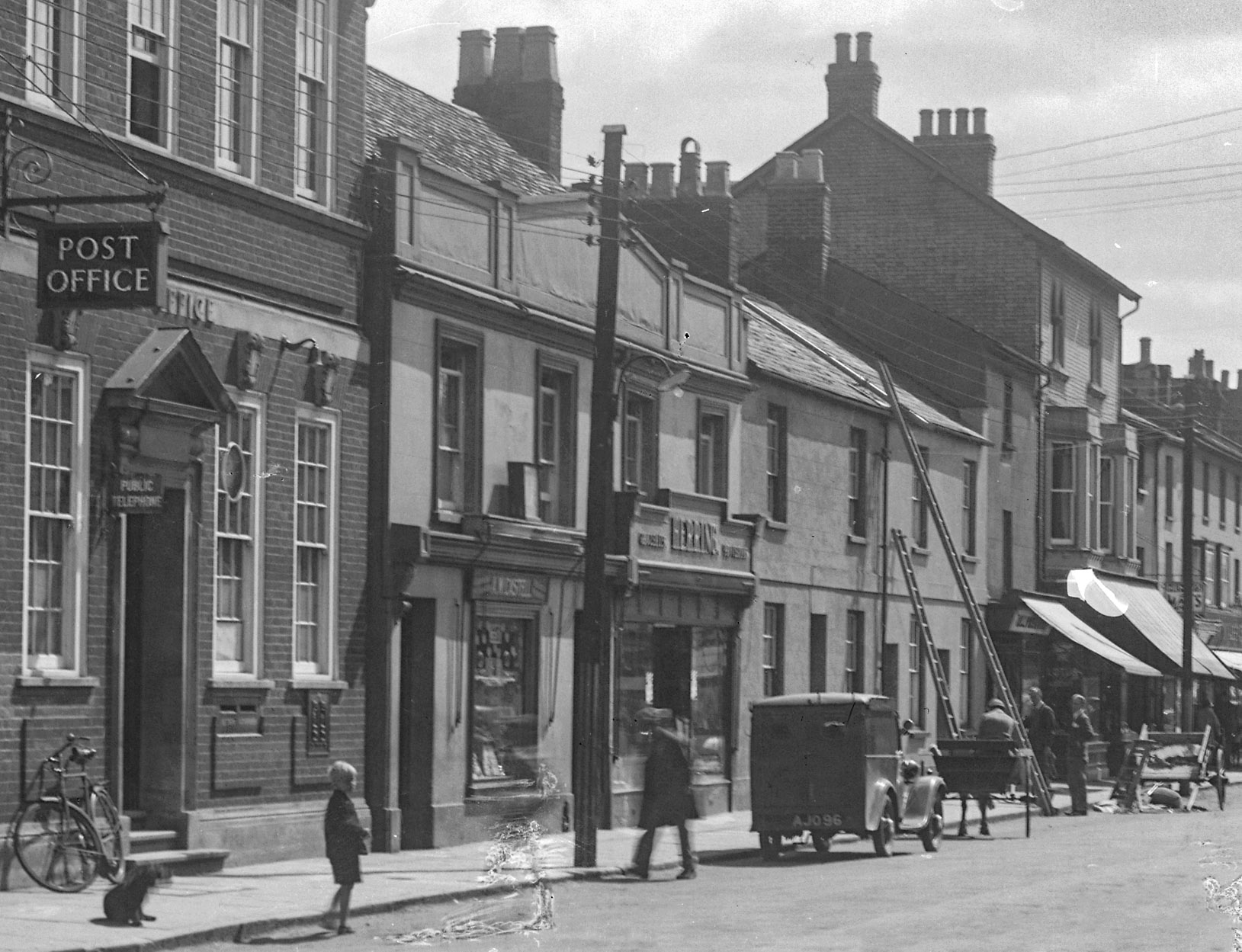
Photograph by Frank Packer, Aug 1937 - Philip Herring, grocer's shop, 52 Sheep Street, Bicester
(reference: D297061a)
By 1944, with rationing and other war-time restrictions, the Herring’s Blackthorn bakery was in difficulties and closed. By this time John was sixty years old and wanted to concentrate on his meal business and the farm. Both Tom and Harold also had retired from their bread rounds. For a while these passed to other bakers who were likewise unable to compete with the onward march of the supermarkets and the mass produced, pre-sliced, plastic-wrapped, uniform loaf, and so, the Herrings’ Blackthorn Bakery, like so many village businesses and institutions: the shop, the pub, the post office, the school, passed into the history books leaving the tapestry of life that much poorer for it.
Posted by: Marek Lewandowski, photographic volunteer, Oxfordshire History Centre